
date_range
Saturday 31 Oct 2026


 LOCAL EDITION
close
 LOCAL EDITION


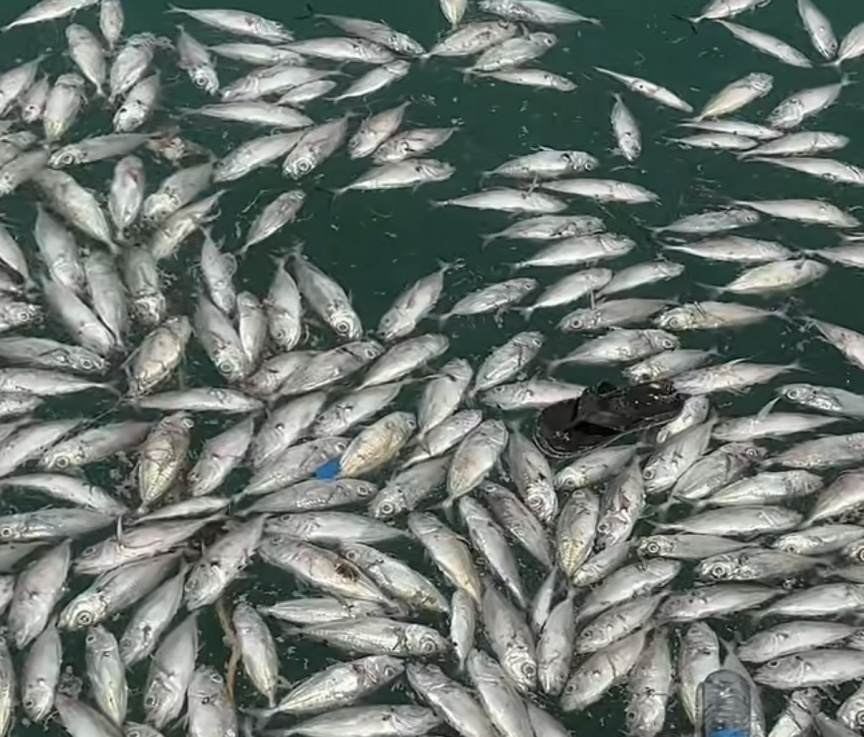
Dead fish float in the N. Velidhoo lagoon on October 31, 2026. (Screengrab/Facebook/Ajwadh Hussain Ajwed)
N. Velidhoo faced mass die-off of fish on Saturday, with hundreds of dead bigeye scad seen floating in the island’s lagoon.
Many locals took to social media to share videos of the scenes at the Velidhoo harbor area.
Hafiza Ibrahim, vice president of Velidhoo Council, initially told Sun the incident took place after a boat that visited the island to refuel on Friday evening dumped water used to cook parrotfish.
She said that multiple witnesses reported seeing them dumping the water into the lagoon.
Hafiza later said that the council was able to verify through the police that the boat in question was engaged in reef fisheries and does not catch parrotfish.

Hafiza said the incident comes at a time when Velidhoo had been seeing a lot of bieye scad swimming in the island’s lagoon.
A lot of people had been going to the harbor in the evening to catch the fish.
Hafiza added that Velidhoo has seen a decline in the number of fishing vessels engaged in tuna fisheries in recent years, and depend on vessels from other islands for tuna purchases.
She said that many of the island’s locals therefore use bigeye scad, locally known as mushimas, in their daily meals.
Hafiza said that while the council initially believed the dumping of water used to cook parrotfish to have been the reason for the mass die-offs, they now believe the incident took place due to oxygen depletion.
Low tide causes fish deaths primarily by trapping fish in shallow puddles or closed reef pools where dissolved oxygen levels drop to fatal levels.
Hafiza described the mass die-off of bigeye scad in the island as “deeply regrettable.”
Hafiza said the council is working on removing the dead fish and cleaning up the lagoon.
“We are cleaning up the lagoon now. There’s a foul stench coming from the lagoon. That’s what would happen right? Having such a large number of fish die? We are burying all the fish in a mass grave,” she said.
The Environment Regulatory Authority (ERA) said they would provide a comment after looking into the incident, while the police were not immediately available for comment.
Parrotfish are not naturally venomous or inherently poisonous by themselves, but they can cause ciguatera fish poisoning in humans if eaten. However, there’s no evidence of it being toxic to other sea life.
The colorful and voracious herbivores spend up to 90 percent of their day eating algae off coral reefs with their beak-like teeth. This grazing action creates space for coral larvae to settle and promotes coral growth while also preventing coral reefs from becoming overgrown with algae. They are also responsible for producing up to 80 percent of the sand on outer reefs that replenishes Maldivian beaches and lagoons.
The Maldives added parrotfish to the endangered species list in 2020, making catching, killing, keeping, trading, or displaying any species of parrotfish is completely illegal.


