date_range
Sunday 15 Nov 2026


 LOCAL EDITION
close
 LOCAL EDITION


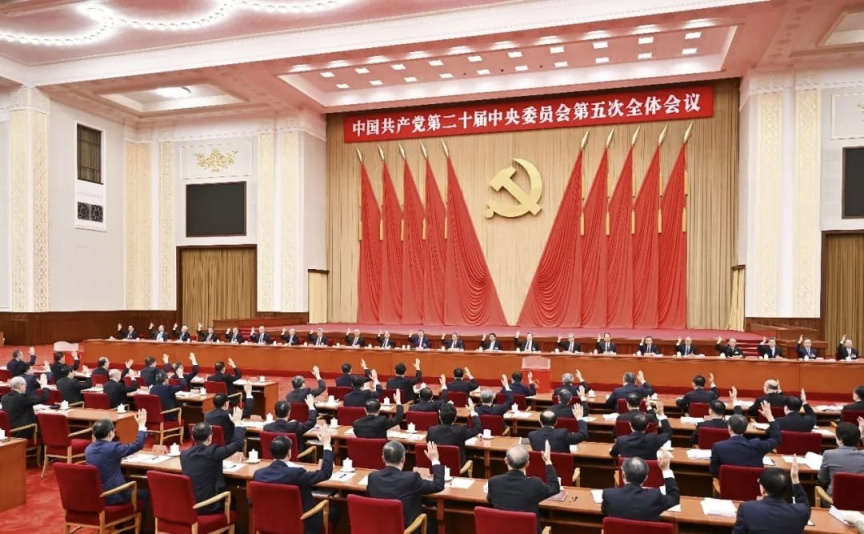
Captures from a CPC meeting.
The following is an op-ed written by He Fen, Chargé d’Affaires ad Interim of the Embassy of China in the Maldives.
___
Political parties across the world today commonly face such acute challenges as fractured social consensus, declining representativeness, weakened governance capacity, and frequent corruption. Party polarization, inadequate state governance, and a social trust deficit are becoming increasingly intertwined. The World Values Survey (2017-2022) shows that, across 39 countries, average public trust in political parties stood at only 17.1%, whereas public satisfaction with the Communist Party of China (CPC) has remained above 90% for consecutive years. Many are turning their eyes to China: at a time when party politics in many countries is beset with difficulties, how has the CPC emerged from more than a century of vicissitudes with its vigor intact?
The Fifth Plenary Session of the 20th Central Committee of the CPC may offer an answer. In October 2026, the Session deliberated and adopted the Resolution of the Central Committee of the Communist Party of China on Certain Major Issues concerning Persevering with Full and Rigorous Party Self-Governance. The Resolution systematically reviews the achievements and experience of full and rigorous Party self-governance in the new era, provides an in-depth analysis of the situation and tasks facing Party building at present and in the period ahead, and sets out strategic plans for persevering with full and rigorous Party self-governance. Full and rigorous Party self-governance is precisely the success code of “the governance of the CPC”.
The CPC has attached great importance to managing and governing itself in every historical period. Before the 18th CPC National Congress, however, there was a time when Party leadership was weakened, rendered nominal, or diluted, when Party self-governance was neither strict nor substantive nor effective, and when some problems within the Party were shocking in their severity. Since the new era began, the Party Central Committee with President Xi Jinping at its core has made a major strategic decision to exercise full and rigorous Party self-governance. It has taken simultaneous action on ideological work, oversight, discipline enforcement, official management, conduct, and anti-corruption, opening a new realm of self-reform for a century-old party, driving historic achievements and historic changes in the cause of the Party and the country, and seizing the historic initiative for the Party and the people to build a strong party and a strong country.
Since the new era began, the Party Central Committee with President Xi Jinping at its core has opened its effort by formulating and implementing the Central Committee’s Eight-Point Decision on Improving Party and Government Conduct, persistently improving conduct and tightening discipline, addressing the “Four Malfeasances” with the determination of driving a nail, opposing privilege-seeking mindsets and practices, and resolutely rectifying misconduct and corruption that affect people’s daily lives. It has put a stop to some unhealthy tendencies that had long gone unchecked and remedied some chronic problems that had persisted for years. In anti-corruption work, for example, with the sense of mission that it is better to “offend a few thousand than let down 1.4 billion people,” President Xi Jinping has removed ills and restored order, advanced the integrated effort to ensure that officials dare not, cannot, and do not want to be corrupt, and taken a multi-pronged approach of “taking out tigers,” “swatting flies,” and “hunting down foxes.” The anti-corruption struggle has won an overwhelming victory and has been comprehensively consolidated. Since the 18th CPC National Congress, disciplinary inspection and supervisory organs nationwide have filed 8.105 million cases and taken disciplinary action against 7.922 million people, showing the world a resolve to “turn the knife inward and cut out one’s own rotten flesh.”

Public support is the greatest politics and determines the rise and fall of any cause. It is precisely by persevering with full and rigorous Party self-governance that the CPC has been able to forge itself into “a piece of hard steel,” pool the mighty synergy of society working with one heart, implement the major decisions and plans of the Party Central Committee with the precision of an arm directing its fingers, turn the Party’s political and organizational strengths into strengths for victory, and continue to write the two miracles of rapid economic development and long-term social stability. China has built the world’s largest and most comprehensive industrial system, with its value-added manufacturing output ranking first in the world for many years running. It has fostered a middle-income group of more than 400 million people and historically resolved the problem of absolute poverty, lifting hundreds of millions of rural poor out of poverty. China is now advancing toward the goal of reaching the per capita GDP level of a moderately developed country by 2035.
The CPC’s successful practice in managing and governing itself has broken the mental shackles of copying Western models of party governance and offered inspiration to political parties in various countries seeking a governance path suited to their own national conditions. In recent years, party figures from a growing number of countries have come to China to observe the CPC’s practice of full and rigorous Party self-governance at close range and to look for the key to solving their own problems. The Cambodian People’s Party, drawing on China’s experience, has put forward an anti-corruption guideline of “catching both the ‘big fish’ and the ‘small fish.’” The People’s Party of Spain, with reference to the CPC’s internal oversight mechanisms, established a People’s Oversight Office. Sri Lanka’s People’s Liberation Front has translated the Central Committee’s Eight-Point Decision and its implementation rules and the Intra-Party Regulations of the Communist Party of China into the national language and distributed them for study throughout the party. The practical experience of the CPC in full and rigorous Party self-governance is steadily being translated into global public goods for governance.
This year marks the 105th anniversary of the founding of the CPC and the opening year of the 15th Five-Year Plan. In the face of profound changes in the global, national, and Party conditions, the CPC will persevere with full and rigorous Party self-governance, unite and lead the Chinese people in advancing the great cause of building a strong country and national rejuvenation through Chinese modernization, and continue to inject new momentum into global governance innovation for political parties and states through “the governance of the CPC” and “the governance of China,” provide greater certainty for global development, promote progress in human political civilization, and accelerate the building of a community with a shared future for humanity.