date_range
Saturday 24 Oct 2026


 LOCAL EDITION
close
 LOCAL EDITION


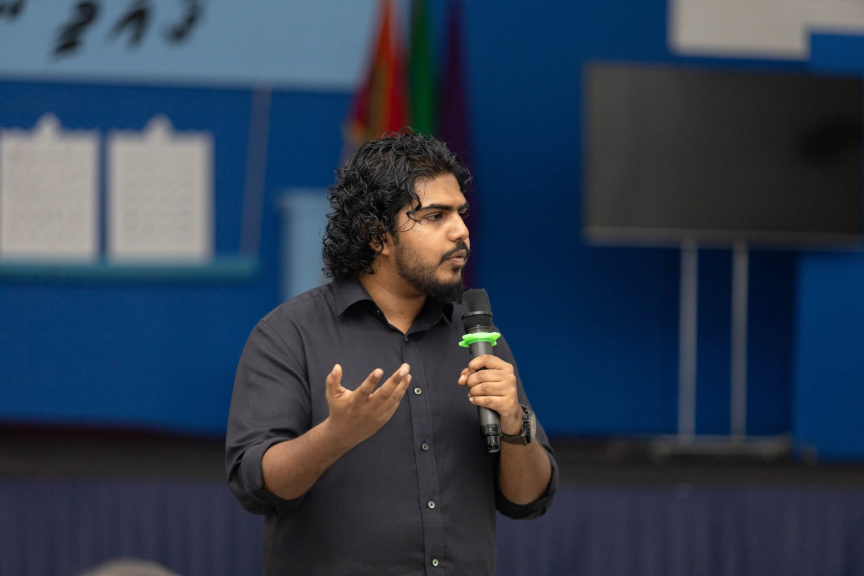
Central Hithadhoo MP Ahmed Azaan Marzooq addresses his constituents during a community meeting on September 6, 2024. (Photo/Ahmed Azaan Marzooq)
While the salaries of Maldivian legislators may appear to be comparatively higher, the global comparison is inaccurate as they are also expected to spend heavily on their constituents out of their own pockets, says Ahmed Azaan Marzooq, a lawmaker from the ruling People’s National Congress (PNC).
Last week, the Parliament’s Public Accounts Committee approved amendments that will see the monthly pay of the Speaker raised to MVR 95,000, along with increasing the car allowance to cabinet ministers and the salaries of local councilors. The decision, given the MVR 82,500 salary, including the committee allowance, already being paid to sitting parliamentarians, has sparked fresh debate over pay equality in the Maldives.
One netizen took to Facebook on Thursday to share a list that compares the salaries of legislators with the average pay of countries.
It shows Maldivian legislators are being paid more than seven times the monthly earnings of an average worker – much higher than countries like Singapore, the United States, Australia or the United Kingdom.
Responding to this post on early Friday, Azaan, the representative for Central Hithadhoo constituency, suggested that it was not accurate to compare the salaries of Maldivian legislators with those of legislators in the countries listed in the table.
He said that in all those countries, parliamentarians receive additional funding for office expenses, travel, staffing and other operational costs, whereas in the Maldives, MVR 77,700 is the only monthly take-home remuneration parliamentarians receive.
He said that Maldivian legislators were also expected to spend heavily on their constituents, while legislators in other countries generally do not face such expectations to the same extent.
“In the Maldives, MPs are also expected to spend on their constituents. Many people regularly call asking for financial assistance. Since we come from small island communities, it is difficult to ignore such requests because it is almost always someone you are related to or someone you know personally,” he wrote on Facebook.

Azaan said that parliamentarians are also expected to sponsor numerous events throughout the year.
“School prize days, Eid celebrations, New Year events, Ramadan activities, school sports events, island and atoll-level football tournaments. You name it. Almost every such event will have some contribution from an MP. This is neither our job nor our responsibility, but people expect it,” he wrote.
He said that a British parliamentarian who once visited the Maldives expressed surprise at learning that the Maldivian people have such expectations of their legislators.
“He had been an MP for over 30 years, and during that entire period, he had only once paid for a hotel room for a constituent during an emergency. That was it,” he wrote.
Azaan said that a fair comparison of salaries of legislators should therefore also take into account the expectations and attitudes of the people they serve.
He said that an overwhelming 90 percent of the people who have reached out to him in the two years he has served at the Parliament have done so to ask for personal favors.
“Money, expediting a process, winning a bid, getting something done that they cannot achieve through proper channels, or securing jobs even when they are not qualified for them,” he wrote.
Azaan said that parliamentarians in the Maldives who do not have a secondary source of income often struggle to make ends meet by the end of the month.
“After covering basic living expenses and spending on constituents, there is very little left. Many MPs cannot even afford to visit their own constituencies regularly, because a single trip to some constituencies can easily cost MVR 20,000 or more,” he wrote.
“These are expenses that MPs are expected to bear out of their own pockets, while in many other countries, such costs are covered through separate parliamentary allowances and budgets.”
Netizens responded by pointing out the wider systemic failing that is creating these expectations.
“Why do you think constituents need to ask you for money? Legislators have set up a system where the normal citizens have to beg and depend on legislators for even basic needs such as health care,” wrote one netizen.
Some asked Azaan for greater understanding of the struggle of ordinary citizens trying to survive on a fraction of the salary that parliamentarians receive.
“If MPs earning MVR 77.7k struggle, imagine ordinary citizens surviving on a fraction of that,” wrote one netizen. “A normal citizen earns a small salary, faces the same rising prices, pays rent, buys groceries, covers bills and tries to support a family. After rent and basic expenses, how much is actually left? Many are barely surviving from one payday to the next.”
Many urged Azaan to take the initiative to push for change to end the system of dependency.
The Parliament currently has 93 members. This number is expected to grow further as the population increases, in light of a clause in the Constitution that requires administrative divisions with more than 5,000 residents to elect an additional member of Parliament for every extra 5,000 residents.
The decision to increase the salaries of public officials also comes as the increase in overall state spending over revenue widens the overall budget deficit to MVR 4.5 billion.
International financial institutions have been urging the Maldives government for years to cut costs and implement fiscal consolidation measures to manage its staggering debt.