date_range
Monday 19 Oct 2026


 LOCAL EDITION
close
 LOCAL EDITION


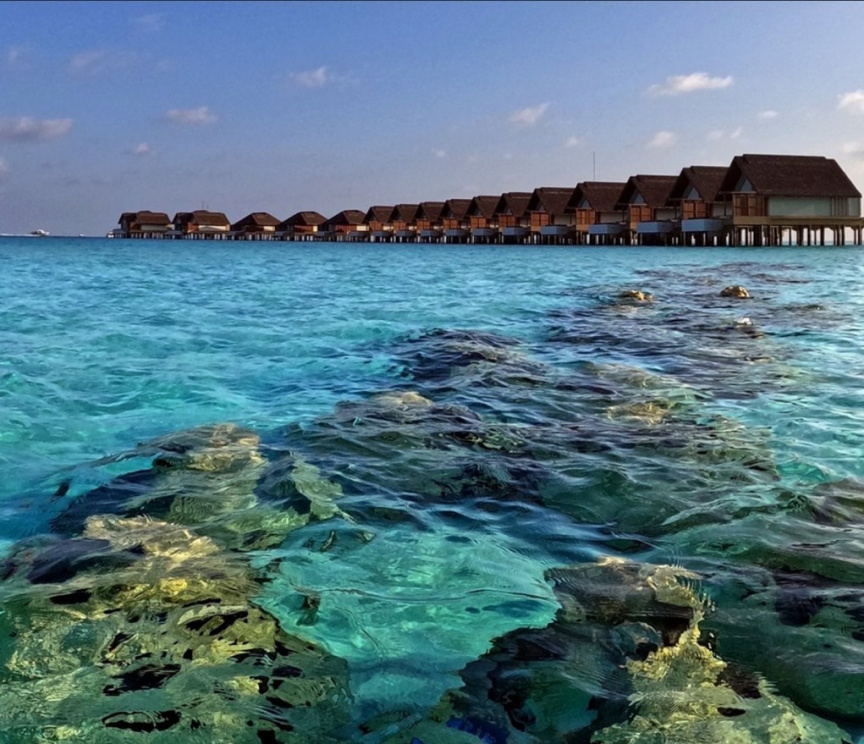
A team of researchers at MIT are using ocean currents to “grow” sandbars and islands in the Maldives. (Photo/MIT School of Architecture and Planning)
A Maldivian resort island hit with sand erosion have used an artificial reef designed by researchers from America’s Massachusetts Institute of Technology (MIT), helping the island’s beach grow double in size over the course of two years.
The successful experiment marks a landmark shift from the most coastal protection method – sand dredging – a practice with steep environmental consequences.
Times of India reports the experiment was carried out at a resort island run by Marriott, where a 300-foot beach was slowly eroding away.

Coastal Assembly, a startup that spun out of MIT research at the end of 2025, uses artificial intelligence to analyze satellite and ocean current data at a shoreline, then plans the layout of custom concrete blocks that can help the sand accumulate naturally via ocean waves.
In the Maldives, the team installed 54 strategically placed blocks made from marine-grade concrete and local aggregate roughly 150 feet offshore. By dissipating wave energy, the blocks help redirect sand back to the beach that was previously lost, and also help keep the sand in place.
The researchers track changes over time, and can adjust the blocks if needed.
Skylar Tibbits, a professor in MIT’s architecture department who runs the university’s Self-Assembly Lab, told the Times of India that the research started by chance, when he happened to visit a sandbar in the Maldives that emerged naturally in only a month.

He started to understand they could tap into this natural process.
It took Tibbits and his team nearly a decade to find an approach that worked, as they moved from simulations to 10 real-world deployments in the Maldives.
Each design is custom, from how the structures are arranged to their height and depth.
Each structure is also cast with a unique shape so the reef looks more natural than human-made. The artificial reefs, like natural ones, also help protect coastlines during storms.

According to Tibbits, the depth of the beach in the Marriott resort grew by 90 feet within six months, and doubled in size two years later.
The team’s work offers an alternative to traditional coastal protection methods such as dredging sand, which harms coral reefs and only works temporarily, as the sand can quickly wash away.
Meanwhile, building seawalls is expensive, and also isn’t necessarily very effective, as it can end up accelerating erosion on other beaches nearby, or even unintentionally increase erosion at the beach it was built to protect.
Coastal Assembly is expanding its work in the Maldives and beginning to work in other locations in need of coastal protection.