date_range
Sunday 25 Oct 2026


 LOCAL EDITION
close
 LOCAL EDITION


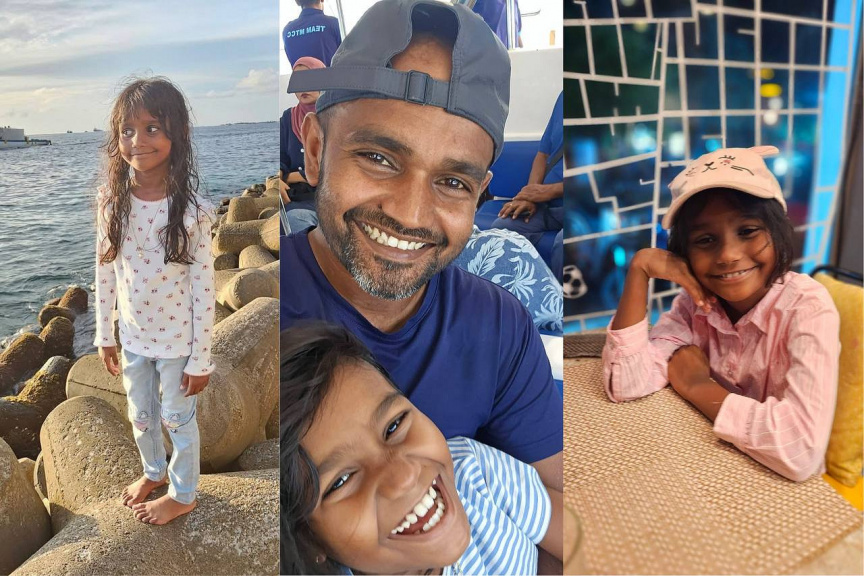
Combined photos of nine-year-old Zeeva Sinan Ahmed, M.Lemon Tree 1/Male’ City and her father Hussain Sinan.
A tragic accident occurred near Vinares-7 in Hulhumale' Phase II last Saturday night, claiming the life of nine-year-old Zeeva Sinan Ahmed, M. Lemon Tree 1, Male' City. She passed away early this morning, leaving behind profound grief for her family, especially her soldier father, Hussain Sinan, who shared a deeply emotional tribute on social media reflecting on his daughter’s short but remarkable life.
When Zeeva moved to Hulhumale' as a young child and lived away from her father, she often felt that boys were “bad people.” But as she grew older, her perspective changed. “Dad, I used to think boys were bad, especially you. I’m sorry. I don’t think like that anymore now that I’m growing up. You’re a good man,” she once told him. According to Sinan, whenever she said “I hate you” in her early years, he would simply smile and tell her it was okay. He said he always kept a home ready for her, a place where she could come anytime and be her father’s “special girl.”
Zeeva was unusually intelligent and organized for her age. She journaled daily, kept detailed plans, and maintained routines with discipline far beyond her years. Sinan described her personality as a mix of strong determination, genuine kindness, and growing thoughtfulness.

The bond between father and daughter was strongest through learning. Sinan wrote that coming home after a hard day’s work and teaching her a new skill was his favourite part of life. He used 'gamification' to teach multiplication tables, and a time segmented approch to help her focus while reciting the Quran, from Surah Al-Fil to the first 45 verses of Surah Al-Baqarah, marking her exceptional intelligence. For science fairs, he told her he cared only about execution, not prizes. She executed flawlessly every time, he said. She memorized entire literature books for spelling bees with her amazing absorption ability, practiced public speaking, often borrowing her father’s own presentation techniques.
Physically, Zeeva was fearless according to her father. She grappled and wrestled with her father, he said, perfecting the rear-naked choke. She snorkeled, roller-skated, and jumped from high places into the sea without hesitation.
Sinan wrote that one of his deepest pains is that she never got to see the pair of skates he had bought as a surprise for her before the accident.

Zeeva was brave, kind and full of heart. She was proud of her siblings, loved playing chess, and enjoyed challenging her father with tongue twisters like supercalifragilisticexpialidocious. She dreamed of pursuing medicine. Sinan cherished cooking her favourite chicken curry, making her sunny-side-up omelets, and taking her out. The two had even been planning an educational trip to Laamu Atoll together.
Her passing has left an immeasurable emptiness in Sinan’s life. Yet even in the hospital, when he saw her monitor lines flatten, he stood by her side remembering his exceptional little girl with deep pride. He wrote that Zeeva was his gentle, kind, hopeful and talented child, “a softer, kinder, female version of me.” And she gave him the best years of his life.

Sinan ended his tribute with these words:
“She is my daughter, Zeeva Sinan Ahmed. She is my best student. She taught me far more than I could ever teach her, and I am grateful for every moment she gave me.”