date_range
Thursday 15 Oct 2026


 LOCAL EDITION
close
 LOCAL EDITION


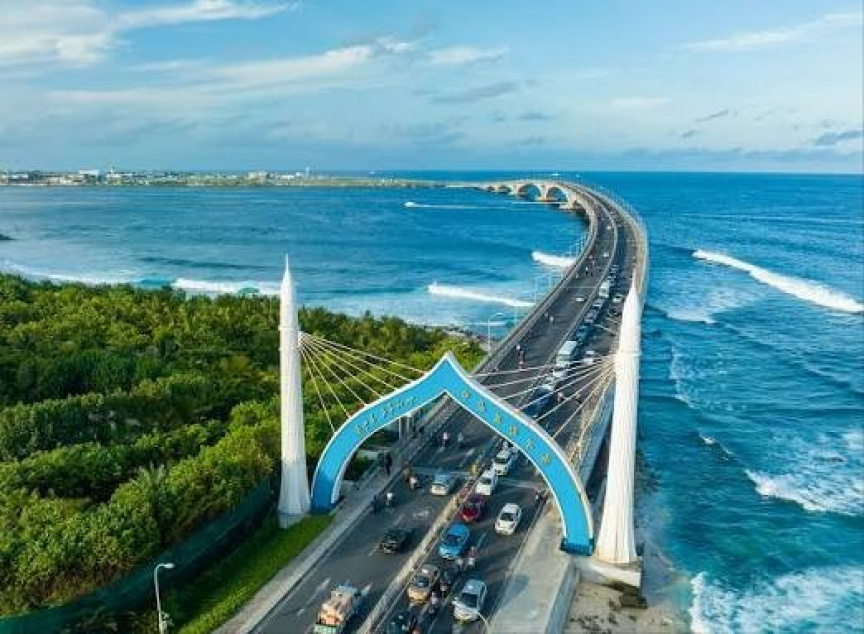
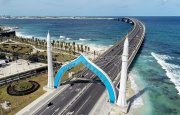
Sinamale' Bridge.
The following is an op-ed written by Kong Xianhua, the Chinese Ambassador to the Maldives.
---
What can a bridge change in eight years?
On August 30, 2018, the China-Maldives Friendship Bridge officially opened to traffic, establishing a direct road connection between Malé, Hulhulé and Hulhumalé. At the time, it was a major and widely anticipated infrastructure project in the Maldives. What people saw was a bridge spanning the sea and linking three islands. Eight years later, what they see is much more: urban areas continuing to grow around the bridge, a steady flow of vehicles and people crossing every day, closer economic links, and conveniences that have become an ordinary part of daily life for many people.
The completion of an infrastructure project may be the most visible moment, but its true value is proven by every day that follows. Looking back over the past eight years, the China-Maldives Friendship Bridge has addressed the Maldives' practical development needs, made daily travel easier, facilitated the movement of people and goods while supporting economic activity, expanded the development space of the Greater Malé area, and become a tangible example of practical cooperation and shared development between China and the Maldives.
The bridge was born of a real need arising from the Maldives' unique geography. Made up of numerous islands, the country has been shaped by the ocean, making reliable connections between islands particularly important. Malé is densely populated and has limited land, while Hulhulé serves as a major transportation hub and Hulhumalé has continued to develop as a new urban center. Before the bridge was built, travel between Malé, Hulhulé and Hulhumalé depended mainly on ferries. A trip typically took 40 to 60 minutes, while services could be suspended in strong winds, heavy swells and other adverse weather conditions. For people crossing between islands every day to work, attend school, seek medical care or travel to the airport, travel time and weather conditions were unavoidable considerations. As the population grew and the urban area expanded, a more convenient and reliable transportation link between the three islands became an increasingly pressing need for the Greater Malé area. The bridge was built to meet that need. In doing so, it crossed not only a stretch of sea, but also one of the physical constraints limiting the capital region's development.

Turning that need into reality required both financing and technology to overcome the fundamental challenges of construction. The China-Maldives Friendship Bridge was financed through a combination of grant assistance from the Chinese government, a concessional loan provided by the Export-Import Bank of China, and funding from the Maldivian government. Confronted with the complex conditions of the open ocean and deep waters, as well as high temperatures and high salinity, Chinese construction teams overcame a series of formidable technical challenges. In just 33 months, the bridge envisioned by the Maldivian people became a reality. A development need was thus translated into a concrete infrastructure project, with cooperation between China and the Maldives taking shape on the ground.
The bridge has since made better transportation an ordinary part of everyday life. After the bridge opened, travel between the three islands was reduced to about five minutes by car. The Greater Malé bus network was subsequently introduced, with daily passenger numbers reaching as high as 7,000. Vehicles and people have crossed the bridge day after day, and journeys between islands that once required careful planning have become an ordinary part of daily life. At the same time, a stable and efficient transport corridor has created closer connections between communities and economic spaces that were once separated by the sea. The growing flow of vehicles reflects broader increases in the movement of people and goods and in economic activity. Since its opening, the bridge has recorded more than 100 million crossings in total, with an average of about 45,000 crossings a day. Inter-island logistics and transportation costs have fallen by approximately 70 percent.
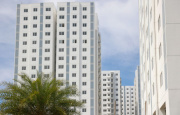
The bridge has also opened up new space for urban growth. It does more than connect three islands. It links homes with jobs, businesses and public services, opening up new possibilities for the future development of the Greater Malé area. Malé has limited land and a highly concentrated population, while the development of Hulhumalé has provided additional space for urban growth. With the opening of the bridge, travel between Malé and Hulhumalé became considerably easier, and Hulhumalé has gradually emerged as an important new urban center helping to ease population pressure on Malé. Hospitals, schools, shopping centers, parks and sports facilities have steadily been added, while businesses ranging from restaurants and retail to vehicle repair have continued to develop. Local employment opportunities have expanded, and a more integrated Greater Malé metropolitan area is taking shape.
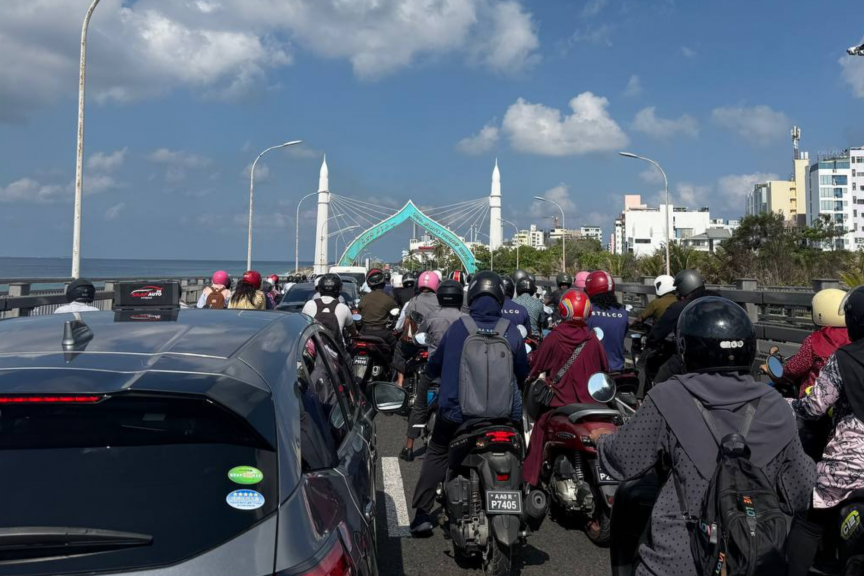
The true value of a project emerges over time, and for a bridge, the real test begins only after construction is complete. For infrastructure, completion is never the end. Its true value lies in its ability to withstand the passage of time and continue serving the communities and people around it safely and efficiently. In recent years, China and the Maldives have continued to cooperate on the bridge's maintenance and management, helping ensure its safe and efficient operation.
2026 marks the fifth anniversary of China's proposal of the Global Development Initiative. Looking back on the bridge's eight-year journey, we can see that China's people-centered approach to development is far from an abstract concept. Ultimately, it must be translated into concrete projects, reflected in improved transportation, greater convenience in people's daily lives, and expanded space for development. For China and the Maldives, the bridge is also a tangible record of a journey of cooperation: starting from shared needs, addressing practical challenges through pragmatic cooperation, and allowing the results of that cooperation to stand the test of time.
The significance of a bridge has never been limited to the bridge itself. It connects three islands, transforms the way people travel, facilitates the movement of people and goods, and expands the space for urban development. At a deeper level, it brings a vision for development into the fabric of everyday urban life.
Eight years is merely a milestone. Traffic continues to flow across the bridge, while the cities and lives it connects move forward.