date_range
Sunday 11 Oct 2026


 LOCAL EDITION
close
 LOCAL EDITION


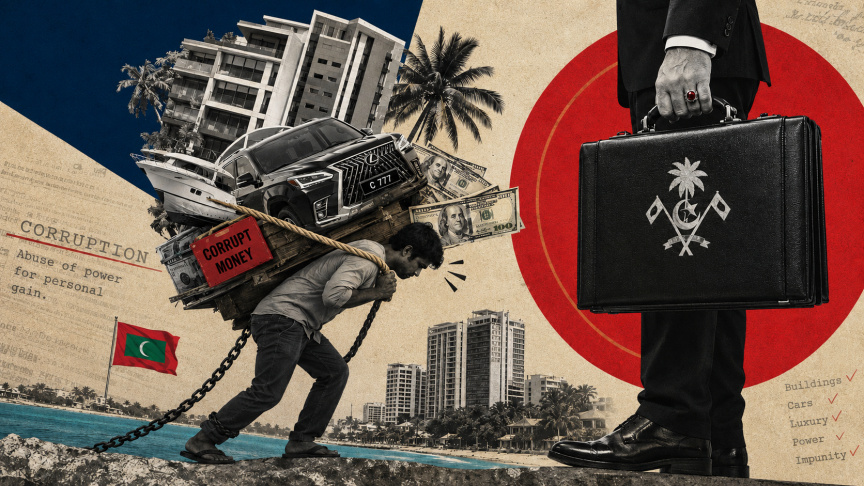
Small companies that operated with just two or three people when a political appointment was secured suddenly receive project contracts worth hundreds of millions of Rufiyaa. Most often without a bidding process, and at inflated prices. Then, we witness that politician suddenly becoming a major tycoon. And the heavy burden of those ill-gotten funds must ultimately be borne by poor citizens. This is the reality of the Maldives yesterday and today.
Corruption in the Maldives is an extreme, systemic, and deeply rooted issue. With governments changing every five years, it is notable that in every administration, the number of individuals acquiring illicit enrichment increases drastically. Across different terms, numerous Members of Parliament and individuals holding various political positions have engaged in repeated acts of bribery and corruption.
After committing such acts, using those funds to secure political protection has become commonplace. It is a visible reality that individuals accused of corruption reside in the top ranks of every political party that has governed the Maldives to date. One of the most crucial measures to halt this practice is the state asset recovery of funds and property acquired through corruption, embezzlement, and crime.
As terms change every five years, the biggest issue in the Maldives is the failure to take adequate action against those who acquire assets through corruption and illicit means. The reason is that they are connected behind the scenes. According to former Home Minister Umar Naseer, governments actively create opportunities for corruption while in power. He stated that this opportunity is granted by splitting the proceeds of corruption into three shares: one share goes to the ruling party of the time, another to the sitting President, and the third share is retained by the individual committing the corruption.

The strongest evidence supporting this statement is that those who steal state assets receive protection whether their party is in power or in opposition. Thieves remain connected to other thieves behind closed doors. Whether looking at the administration of former President Mohamed Nasheed, former President Abdulla Yameen, or the recently concluded administration of President Ibrahim Mohamed Solih, numerous acts of corruption were committed. Each party comes to power accusing the previous government of theft, yet once in power, they commit the very same theft. Similar allegations are being leveled against the current administration as well. Across all these governments, rare is the instance where such matters were investigated and action was taken.
Corruption stemming from the government and state-owned enterprises awarding work at inflated prices causes severe damage to the Maldivian economy. In Transparency International's 2024 Corruption Perceptions Index (CPI), the Maldives ranked 96th with a score of 38 out of 100—a indicator demonstrating the poor state of corruption. With billions of Rufiyaa lost from the state, one of the most prominent examples is the massive MMPRC embezzlement scandal.
Data from the Anti-Corruption Commission (ACC) shows that the state suffered a loss of four billion Rufiyaa due to the MMPRC scandal. However, only 1.04 percent of that amount has been recovered. Furthermore, procuring goods and services through the state procurement system at prices multiple times higher than market value has become routine. Auditor General reports have highlighted numerous such issues. The loss of vast sums from the state budget degrades the quality of health and educational services that must be provided to citizens, hinders the nation's infrastructure development, causes state debt to skyrocket, and increases reliance on foreign entities.
While the nation finds itself in such a condition, the administration of President Dr. Mohamed Muizzu has now drafted a bill regarding the state confiscation of assets derived from crime and submitted it to the People's Majlis. If properly implemented, this is a very good start toward stopping corruption. Provisions of this nature have been included in certain laws previously. For instance, a bill previously submitted to amend the Drugs Act included reviewing procedures for seizing and confiscating assets derived from crime to the state. However, establishing a robust framework under a dedicated law to confiscate ill-gotten wealth will serve as a major deterrent against corruption. If this bill is properly enforced, it will pave the way to recover lost state funds and diminish the incentive to commit corruption.

Looking at other countries globally, nations like Singapore and China—which rank among the lowest in corruption—tackle these issues under strict mechanisms for state asset forfeiture. Looking at how Singapore’s Corrupt Practices Investigation Bureau (CPIB) operates, if a public servant is proven to possess assets or funds disproportionate to their income, it is presumed to be derived from corruption, and the agency holds the power to confiscate those assets to the state. Furthermore, the burden of proof to demonstrate how the assets were acquired rests on the accused party.
Even in China, home to one of the world's strongest economies, strict measures are taken beyond confiscating the assets of those convicted of corruption, including the death penalty. Due to such systems, corrupt acts have been reduced in those countries, and public trust in state institutions has been secured.
If the Maldives also begins confiscating assets derived from crime to the state, state revenue will increase, opening opportunities to utilize those funds for the benefit and welfare of the public. This will ensure that committing corruption is recognized as an unprofitable and dangerous endeavor.
However, what the Maldives must do is not merely pass laws. Enforcing those laws is the most crucial aspect. Institutions such as the ACC, the Police, and the Prosecutor General's Office must be granted full independence to investigate and prosecute corruption cases. Without an enforcement system free from political influence, the mere existence of a law will yield no results.
Until the Asset Recovery Bill becomes law and practical measures are enforced under it, lost state funds cannot be recovered for the citizens. The primary question right now is when the People's Majlis will pass this bill and when real enforcement against corrupt individuals will begin. There are many in the Maldives living openly on illicit enrichment. They must be stopped, and that can be achieved by taking illicitly acquired assets back into the state.