date_range
Friday 16 Oct 2026


 LOCAL EDITION
close
 LOCAL EDITION


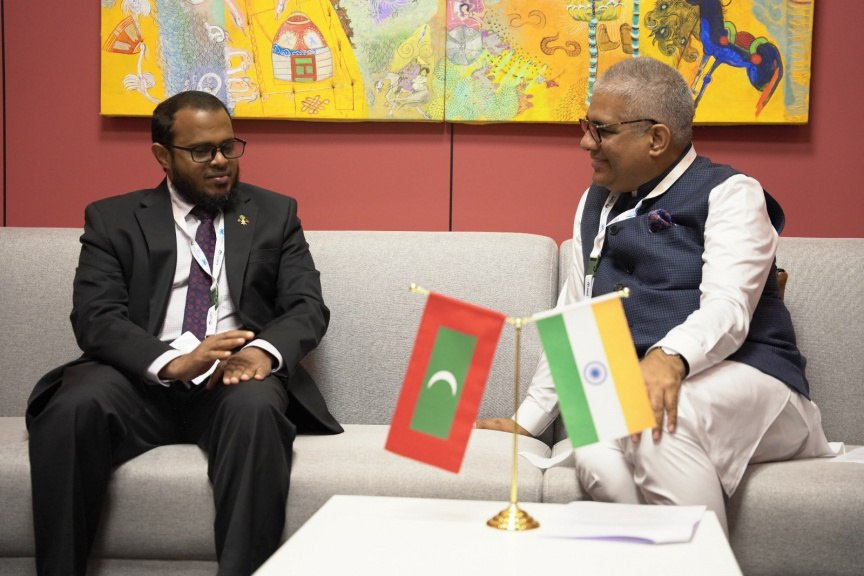
Minister of Climate Change, Environment and Energy Ali Shareef meets India's Union Minister for Environment, Forest and Climate Change, Bhupender Yadav. (Photo/Environment Ministry)
There is a generation of young Maldivians who are watching rocket launches on YouTube, following space missions on social media and dreaming of careers that did not exist in this country a decade ago.
On 27th of this month, Minister of Climate Change, Environment and Energy Ali Shareef met with India's Union Minister for Environment Bhupender Yadav on the sidelines of the COP17 conference. Among the areas discussed was something that stands apart from the usual diplomatic agenda: cooperation in satellite data and space technology between the Maldives and India.
That is a significant conversation. And to understand why, it helps to understand what India has built in space.
India's space agency (ISRO), the Indian Space Research Organisation is one of the most accomplished in the world. In 2014, India became the first country in history to reach Mars on its very first attempt, at a fraction of the cost of comparable missions by other nations. In 2023, India became only the fourth country ever to land on the Moon and the first to land near the lunar south pole. They place India among the elite of global space powers.

What makes ISRO genuinely useful for a country like the Maldives is its earth observation programme. India operates a sophisticated network of satellites, including the Cartosat and Oceansat series — that capture detailed images and data about the earth's surface, coastlines, oceans and atmosphere. These satellites monitor coral reefs, map islands, track ocean temperatures and detect environmental changes across vast stretches of sea. The Indian National Centre for Ocean Information Services draws on this data to provide ocean forecasting across the entire Indian Ocean region.
All of this technology the data, the analysis, the expertise behind it is what India has offered to share with the Maldives.
The discussions also covered capacity building and strengthening institutional ties between the two countries. This is the part that matters most for the next generation. Technology transfer and training are how a small nation builds its own capability over time, not by depending forever on others, but by learning, developing expertise and eventually standing on its own.
India has built one of the world's great space programmes from a developing country base, through investment in science, engineering and human talent. That journey holds its own inspiration for the Maldives.
A partnership in space technology is no longer beyond our reach. The conversation has started. Now it needs to go further.