date_range
Monday 26 Oct 2026


 LOCAL EDITION
close
 LOCAL EDITION


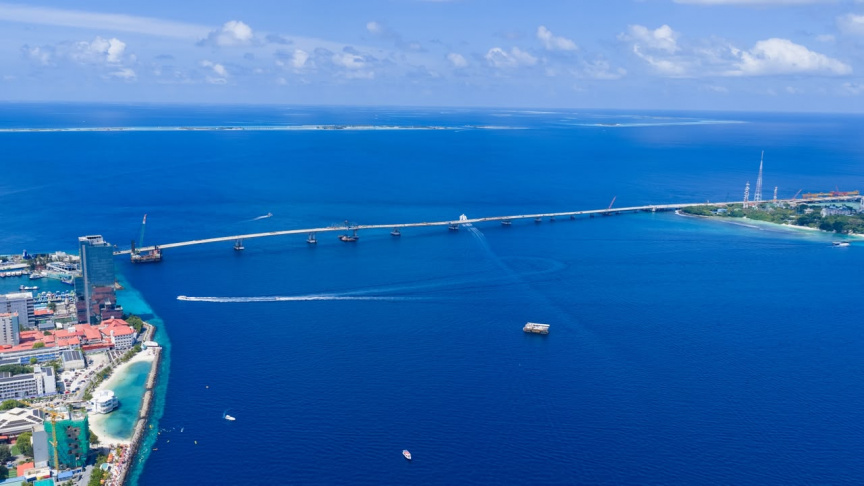
Aerial view of Thilamale' Bridge, connecting Male' city to Villimale'. (Photo/Ministry of Infrastructure, Housing and Urban Development)
Yesterday, the final segment of the Malé–Vilimale superstructure was launched into place. A milestone that engineers, workers and planners had been working toward for years quietly became real — steel and concrete meeting across open water for the last time on this stretch, completing the skeletal picture that those who travel between the two islands have been watching take shape for months.
It is the kind of moment that deserves to be paused on. Not just for what it means in construction terms, but for everything it carries with it.
The Thilamale' Bridge, formally the Greater Malé Connectivity Project is the largest infrastructure project in Maldivian history, funded through a USD 500 million package from India comprising a grant and a line of credit. It will ultimately link Malé, Vilimale, Gulhifalhu and Thilafushi through a 6.74 kilometre network of bridges and causeways. Yesterday's milestone marks the completion of the superstructure on the Malé–Vilimale section; the most visible and symbolic stretch of the project. Work continues: railings, walkways and road surfacing are still to come, and the broader connections to Gulhifalhu and Thilafushi remain in progress. But the hardest and most defining structural work on this section is done.
And that is worth marking — because this milestone is not only about engineering. It is about confidence.
There has been no shortage of debate in recent years about the Maldives' relationships with its development partners — about which country to trust, which projects deliver and which remain promises. Against that backdrop, what the GMCP demonstrates is straightforward and powerful: India came, India built, and the structure is standing.

No matter which government has been in power in the Maldives, India has continued to work on this project. That consistency matters. Development partnerships are ultimately judged not by their announcement, but by their delivery. And delivery which is visible, touchable, rising out of the water is what Maldivians are now seeing with their own eyes. That builds a kind of trust that no diplomatic statement can manufacture.
The economic significance of what comes next is enormous.
Vilimale is about to change. With the bridge connection comes physical integration into the capital Male’, and with that, the conditions for real economic development. A new hospital is under construction in Vilimale, a facility that will serve not only island residents but reduce the pressure on Malé's overstretched healthcare infrastructure. Better connectivity means that hospital becomes accessible to a far wider population. It means property in Vilimale becomes more attractive. It means businesses will follow people, and people will follow opportunity.
Meanwhile, the shift of the main seaport to Thilafushi is one of the most consequential economic decisions in recent Maldivian history. Malé's existing port sits in the heart of the most congested urban space in the country. Moving it to Thilafushi and connecting that island properly through the GMCP — frees up land, reduces cargo traffic through the capital and positions Thilafushi as the country's primary logistics and industrial hub. The ripple effects on how goods move, how costs are distributed and how businesses operate across the country will be felt for decades.

Gulhifalhu, earmarked for residential development, adds another dimension. Housing in Malé is expensive and scarce. The ability to develop affordable homes on a properly connected island nearby is not a luxury — it is a necessity for a growing population that has long been squeezed into one of the most densely populated places on earth.
All of this flows from a bridge. From the decision, years ago, to connect these islands rather than leave them isolated from each other.
Yesterday, the most critical structural work on the Malé–Vilimale section reached its conclusion. The superstructure is up. What remains is finishing work — and then, when the road finally opens, what was once a ferry ride defined by timetables and weather becomes a crossing you take whenever you choose. Down that road comes a hospital, a new port, new homes and new possibilities for thousands of Maldivians who have been waiting patiently for this country to give them more room to grow.
The structure stands. The partnership that built it stands with it. And the best of what this bridge was always meant to deliver is still on its way.