date_range
Sunday 18 Oct 2026


 LOCAL EDITION
close
 LOCAL EDITION


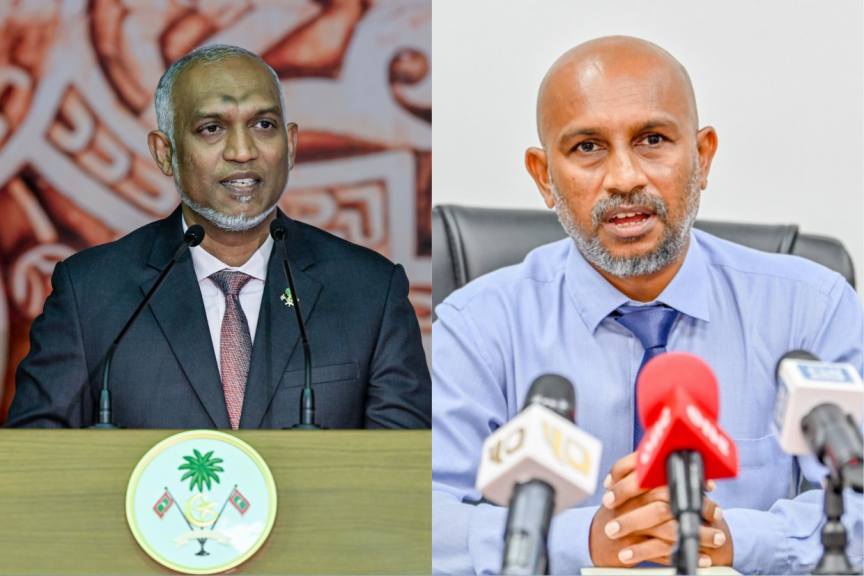
Combined photos of (from L-R) President Dr. Mohamed Muizzu and Information Commissioner Ahmed Ahid.
President Dr. Mohamed Muizzu has labeled Information Commissioner Ahmed Ahid as an anti-government figure who receives order to act against his administration.
He made the allegation during a ceremony held on Sunday morning to mark the Maldives’ 61st Independence Day.
In his address, President Muizzu said that when talking about independence in general, it was also important to talk about independence in governance.
He said that implementing good governance in its true sense was one of his administration’s top priorities.
“It is also one of the key tenets of democracy. To get things done in a transparent manner,” he said.

President Muizzu said that all government ministries achieved full compliance with the minimum proactive disclosure requirement under the Right to Information Act back in June, marking the first time for the requirement to be met since the Act’s enactment in 2014.
“The person running the Information Commission is an opposition figure. He was appointed by the previous administration. He, someone who receives orders to work against us politically, certainly would not announce this if we weren’t in compliance, right?” he said.
President Muizzu said that state-owned enterprises have also been following suit in meeting proactive disclosure obligations.
He said that his administration has been exemplary in responding to RTI requests, holding press conferences, giving interviews, sharing information with the public and working closely with the press.

Ahid was appointed as Information Commissioner on September 6, 2021, back during President Ibrahim Mohamed Solih’s administration.
Back in May, Ahid expressed concern that no government ministry was in full compliance of proactive disclosure obligations. On June 7, he provided an update that the President’s Office and all 16 ministries were now in full compliance with the obligations.
While government ministries managed to meet its minimum proactive disclosure obligations, state institutions, including the President’s Office, continue to face criticism for failure to disclose information in response to requests filed under the RTI Act.
Some of the cases, including the refusal to disclose the number of political appointees, have resulted in court battles.