date_range
Sunday 25 Oct 2026


 LOCAL EDITION
close
 LOCAL EDITION


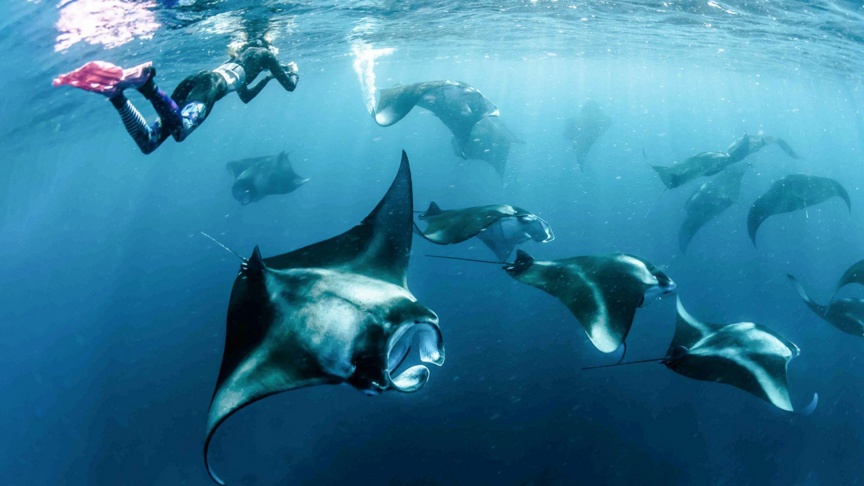
People swim amid Manta rays at Hanifaru Bay in Baa atoll. (Photo/ZuBlu)
A recent study has revealed that manta ray tourism in the Maldives has grown by 380 percent over the past several years, emerging as a major contributor to the national economy, with the industry projected to generate more than USD 311 million annually in direct benefits for local businesses, employees and the government.
The research, published in the scientific journal, Public Library of Science (PLOS One) highlights that while manta ray populations are declining globally, the Maldivian tourism model demonstrates how conservation and economic development can coexist, generating substantial revenue while supporting the protection of the species.

According to the study, manta ray tourism in the Maldives generated an estimated USD 227.3 million in total revenue in 2021. This included USD 39 million from direct manta ray viewing excursions and a further USD 188.3 million in associated spending. The sector accounted for approximately 2.6 percent of the country's Gross Domestic Product (GDP). The industry has expanded significantly since 2008, with around 80 percent of tourism operators in the Maldives now offering manta ray viewing experiences.
The study further notes that the economic value derived from live marine wildlife through tourism substantially exceeds the returns generated through fishing and commercial sale. As an example, a single live shark in the Maldives is estimated to generate USD 33,500 over its lifetime through tourism-related activities, compared to only USD 32 if caught and sold. As governments increase investment in conservation efforts, wildlife tourism has increasingly been recognized as an effective global strategy for safeguarding biodiversity.

The Maldives is widely regarded as the world's leading destination for manta ray tourism. The country is home to 101 identified manta ray viewing sites, including the internationally renowned Hanifaru Bay in Baa Atoll, which hosts the world's largest known aggregation of reef manta rays. The species holds considerable cultural and ecological significance within Maldivian communities.

Despite the sector's continued growth, manta ray populations remain vulnerable to threats including climate change, industrial fishing activities and the impacts of poorly managed tourism. Given the species' slow growth rate and low reproductive capacity, the study underscores the urgent need for comprehensive management and conservation measures to ensure both the long-term survival of manta rays and the continued economic viability of the industry.