date_range
Wednesday 14 Oct 2026


 LOCAL EDITION
close
 LOCAL EDITION


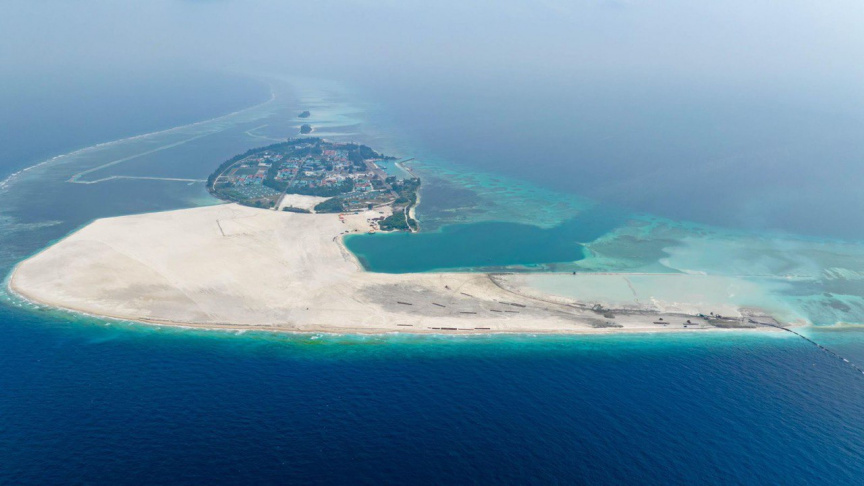
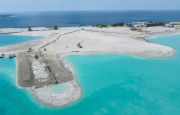
Land reclamation works in progress in Th. Vilufushi. (Photo/MACL)
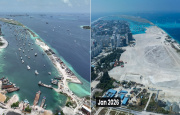
The Maldives has reclaimed more land in the past 24 years than the combined total reclaimed across Europe and Africa, according to a new study analysing the country’s rapid coastal transformation.
The study, Land Reclamation in the Maldives: Trends and Impacts from 2000 to 2024, by Hussain Ziyath, Eden Rigo and Fathimath Shanna, is the first national‑scale assessment of reclamation carried out across inhabited islands.
According to the findings, more than 4,000 hectares of new land were created between 2000 and 2024. A total of 109 reclamation projects were identified across 69 inhabited islands, meaning one in every three inhabited islands has undergone reclamation.
The Central Region accounts for 71 percent of all reclaimed land, with Kaafu Atoll alone representing more than half of the national total.

The study also shows a sharp rise in reclamation following the country’s transition to a multi‑party political system in 2008. The single biggest surge occurred in 2023, when 25 projects were launched nationwide, the highest number recorded in any year.
Beyond the headline figures, the authors highlight several deeper structural issues shaping reclamation in the Maldives:
Globally exceptional scale: The Maldives is now one of the most intensely transformed coastal nations in the world relative to its size.
Artificial islands dominate land volume: While extensions of natural islands make up 90 percent of projects, artificial islands account for nearly 40 percent of all reclaimed land, driven by mega‑projects such as Hulhumale', Gulhifalhu and Ras Male'.
Demographic mismatch: Major reclamation continues in islands with low or stagnant populations, despite sustained migration toward Greater Male'.
Political incentives: The surge in projects after 2008 suggests reclamation is influenced by political cycles and electoral incentives.
Infrastructure duplication: Airports and other major facilities are repeatedly built within the same atolls, reflecting weak national‑level planning.
Climate vulnerability: Standardised engineering designs ignore island‑specific geomorphology, increasing erosion, flooding, drainage failures and the loss of natural coastal defences.
Weak environmental oversight: Environmental Impact Assessments suffer from pre‑approval of projects, limited transparency and poor compliance monitoring.
Record‑breaking year: 2023 saw the highest number of new reclamation projects in the 24‑year dataset.

The study concludes that while reclamation remains an important tool for a land‑scarce nation, undertaking projects without coherent planning, strong regulation and environmental sensitivity “risks exacerbating vulnerability rather than reducing it.”
It calls for the government to align reclamation policy with population trends, environmental resilience and economic priorities as part of the 2024 National Development Masterplan.
The authors bring extensive expertise to the study.

Eden Rigo is an MPhil candidate in Development Studies at the University of Oxford and a 2025 Western Australian Rhodes Scholar, with First Class Honours in Urban and Regional Planning.
Fathimath Shanna is an urban planning consultant at the Ministry of Construction, Housing and Infrastructure, with more than a decade of experience in land use planning and an Australia Awards scholarship background.
Hussain Ziyath is a former Chief Planning Officer at the Housing Development Corporation and a specialist in architecture and urban planning.