date_range
Wednesday 26 Aug 2026


 LOCAL EDITION
close
 LOCAL EDITION


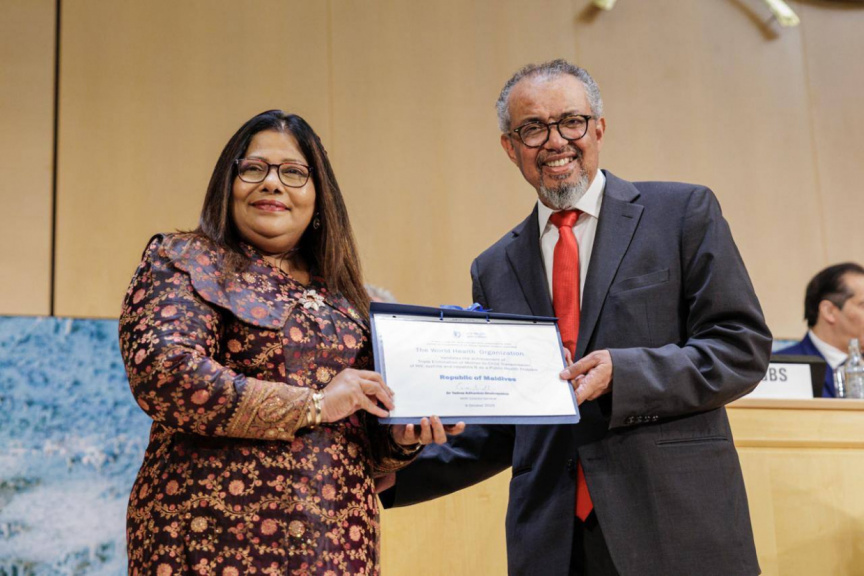
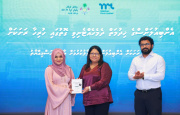
Health Minister Geela Ali receives the certification declaring Maldives the first country to achieve Triple Elimination of mother‑to‑child transmission of HIV, syphilis and hepatitis B at the 79th World Health Assembly. (Photo/Ministry of Health, Family and Welfare)
Health Minister Geela Ali has said that a strong, well‑financed and independent World Health Organization (WHO) is vital for small countries such as the Maldives.
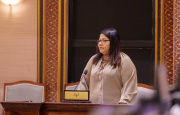
Delivering the Maldives’ national statement at the 79th World Health Assembly, Minister Geela said global health systems are under immense strain as conflicts continue to displace communities and destroy essential services. She added that rising costs, inflation and economic instability are placing additional pressure on national health systems worldwide.
For Small Island Developing States like the Maldives, Geela described the climate crisis as “already a public health emergency,” noting that the country faces interconnected challenges that directly affect health outcomes.
Despite these pressures, she said the Maldives remains committed to building “a resilient and equitable health system,” highlighting continued progress in communicable disease elimination and maternal and child health.
Geela said the Maldives is confronting the growing burden of non‑communicable diseases through preventive measures, including taxation on unhealthy products and the country’s “historic generational tobacco ban to protect future generations.”
For #SIDS spread across vast oceans, #DigitalHealth only works with strong international collaboration. Minister @geelaali at #WHA79 “Right-Sized Excellence,” led by Republic of Malta & co-hosted by the Maldives. pic.twitter.com/Uh2PxwUrZQ
— Ministry of Health, Family and Welfare (@MoHmv) May 19, 2026
She reaffirmed the government’s commitment to Universal Health Coverage, saying the Maldives is strengthening social health protection across its dispersed islands, expanding digital health services, and ensuring access to care for communities in remote atolls. She also noted ongoing investments in developing the health workforce through training, capacity‑building and measures to ensure long‑term sustainability.
Geela said these achievements would not have been possible without the technical support and collaboration of WHO and development partners. She expressed appreciation for the continued engagement of international and regional partners working with the Maldives to strengthen health systems and advance equitable access to care.
Concluding her statement, Geela stressed:
“For small states like ours, a strong, adequately financed, and independent WHO is essential.”