date_range
Monday 19 Oct 2026


 LOCAL EDITION
close
 LOCAL EDITION


Traffic congestion near Ghiyaasuddin International School as students leave school after session.
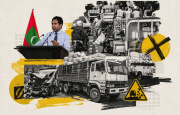
On official working days, the morning, afternoon, and evening hours bring about significant stress for those travelling by road in the Malé area. Whether on the bridge or within Malé itself, the situation remains the same. This is largely because the times when children go to and from school coincide with peak traffic congestion across the city. Although Malé is among the most densely populated cities in the world relative to its size, the sheer volume of vehicles on the roads during school hours brings the entire system close to a standstill. This is the unfortunate consequence of years of failing to establish an effective system.
Rather than thousands of parents individually transporting children in separate vehicles, the immediate establishment of a robust school bus system is essential. According to experts, a single bus can remove 20 to 40 vehicles from the road. For a small island such as Malé, this represents a substantial improvement. Shifting away from a culture in which each family relies on private transport, and instead adopting a system where students are undertake transportation via organized public transit, would benefit the community as a whole.
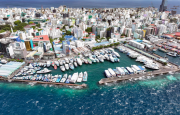
In the Greater Malé area, there are over 119,000 registered vehicles, of which more than 103,000 are motorcycles. Malé and Hulhumalé together comprise approximately 650 hectares of land, equating to 183 vehicles per hectare. Within such a confined space, when thousands of motorcycles enter the roads simultaneously during morning and afternoon school runs, traffic congestion intensifies to extreme levels.

Discussions with traffic police uncovered that on school days, congestion increases severalfold between 7:00 AM and 9:00 AM. This creates significant barriers for both general public transportation and emergency services.
"The behaviour of some parents also worsens the congestion. If you stop near a school, you will see that every parent wants to stop exactly in front of the school gate. This is also a reason for the gridlock," an official from a relevant authority stated.
The implementation of a school bus system would substantially reduce the number of vehicles on the road during these periods. At a time when vehicle numbers exceed road capacity, introducing a dedicated transportation system for schools is among the most practical solutions to the traffic crisis. Such practices have been standard in developed nations for nearly a century, yet the Maldives continues to struggle to implement them even as it reaches 2026.
Road safety is another critical reason why a school bus system is necessary. A significant proportion of accidents in the Maldives result in serious injuries to young people and children, and police statistics indicate that accident rates are rising at an alarming pace. Children travelling to school on motorcycles with parents or on foot face considerable risks when crossing roads due to reckless driving and illegally parked vehicles. Even low-speed accidents in congested areas pose a high risk of serious injury to young children. As school buses are among the safest modes of transportation for students, such a system would greatly reduce their exposure to these hazards. While travelling by bus, children remain in a secure environment. Additionally, a system in which buses stop close to school entrances would provide considerable reassurance to parents.
The time parents spend transporting children to and from school also has a significant impact on productivity. Each day, many parents devote hours to commuting, waiting at school gates, and returning home. This contributes to issues such as lateness to work and reduced working hours, particularly affecting the start of the day in government offices. Furthermore, families without private vehicles and parents whose employment does not allow flexibility face substantial challenges. Some children must walk long distances, while others depend on less safe transportation options.
Therefore, a comprehensive school bus system is not merely an educational policy; it is also an economically beneficial initiative and an important step toward ensuring equal opportunities for all children. By reducing the time burden on parents, overall productivity would increase, contributing positively to the national economy.

Malé was not designed to accommodate its current population density or the vast number of vehicles. Because schools are distributed across the island rather than centralized, travel is required in all directions. This also has notable environmental consequences. Although Malé’s air quality is generally at a good range, the prolonged idling of vehicle engines near schools during peak traffic periods contributes to localized air pollution and the accumulation of harmful gases. This poses health risks, particularly for children. Reducing the number of vehicles on the road would lead to cleaner air, making Malé a healthier and more hospitable environment. A school bus system would represent a significant step toward environmental protection by consolidating transportation and reducing emissions.
New to the Maldives, but not to the world
In many developed countries, school bus systems are widely established. In nations such as the United States and the United Kingdom, dedicated buses are used to transport schoolchildren. In space-constrained countries like Singapore, public transit buses are specifically utilized for student transport during school hours, eliminating the need for additional parking infrastructure.
In a small and densely populated island like Malé, the importance of such a system is even greater. Adopting a model similar to Singapore’s, existing public buses or mini-buses could be assigned to special routes during school hours. International experience demonstrates that a well-designed school bus system is one of the most effective solutions to urban traffic congestion. There is strong reason to believe that such a system could be successfully implemented in Malé.
Some private schools, such as Ghiyasuddin, already provide this service, safely transporting children from Hulhumalé to Malé. This demonstrates that such a system is feasible within the Malé context.
While MTCC has introduced a mini-bus service in Malé with free transport for students, this does not yet constitute a fully developed school bus system. A comprehensive system should enable parents to confidently send their children to school independently, through an organized network that collects students from various locations and ensures timely arrival.
The challenges faced in Malé during school hours extend beyond traffic congestion; they reflect a significant gap in the transportation system and impose a considerable burden on parents. Establishing a robust school bus system is no longer merely a matter of convenience. It is essential for student safety, time efficiency, and the enhancement of national productivity. The time has come for the relevant authorities to take decisive action and implement an official school bus service without delay.