date_range
Tuesday 13 Oct 2026


 LOCAL EDITION
close
 LOCAL EDITION


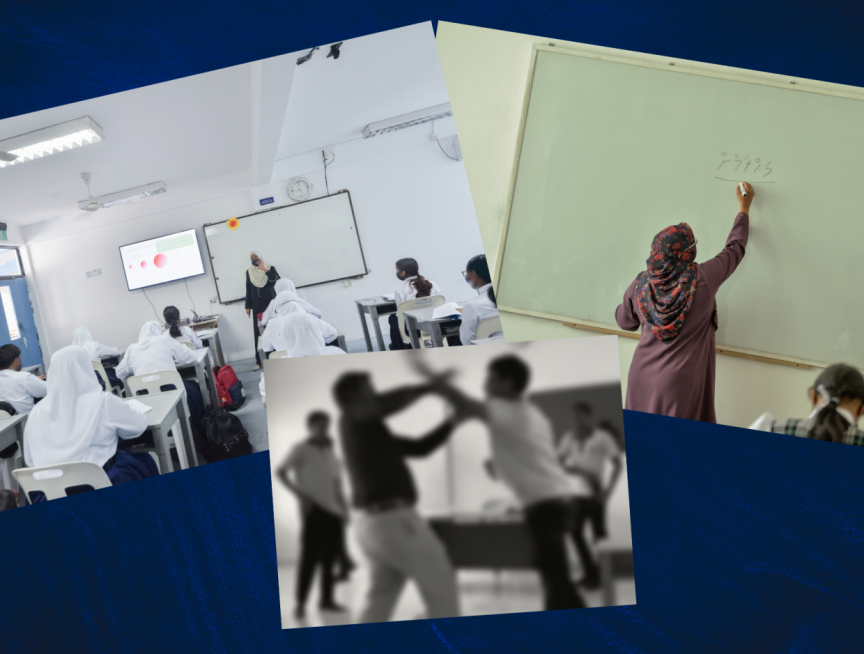
According to statistics released by Singapore’s Ministry of Education—a country often regarded as a model by the Maldives—an average of three bullying cases were reported for every 1,000 primary school students, and eight cases for every 1,000 secondary school students between 2021 and last year.
The Singaporean Ministry of Education stated that these figures represent an increase compared to data recorded between 2019 and 2023.
These statistics point to a growing and concerning trend among students in the country. As a result, Singapore introduced a “strict” measure on April 15th to address the issue.
Under the new policy, corporal punishment, including caning or light physical discipline, is permitted for students involved in bullying or other serious disciplinary offenses. Depending on the severity of the misconduct, students may also face suspensions ranging from one to 14 days, in addition to deductions in conduct marks.

Singaporean authorities stated that the aim of the policy—which combines disciplinary action with counseling—is to ensure consistent disciplinary standards across all schools. The policy is scheduled to be implemented nationwide by 2027.
The news drew significant attention among Maldivians yesterday, with many expressing support for similar measures. However, alongside these expressions of support, a different concern was also raised.
“This would never happen in the Maldives. There are too many rights here. Rights have expanded to the point where they are being misused,” one member of the public said.
As various forms of negative behavior continue to emerge among students within the Maldivian education system, one of the most prominent debates centers on whether students have “too many rights.” The question increasingly being raised is: what about the rights of teachers affected by these student protections? And is this truly the reality of the current situation?
Rising Bullying Cases and Fear Among Teachers
Several months ago, the Maldives was shaken by an incident at Addu High School involving a confrontation between a foreign male teacher and a student. Investigations revealed that the student had allegedly been bullying and harassing several foreign teachers over an extended period. The incident reportedly occurred after the teacher reached his limit following repeated harassment.

Before public attention on that case had subsided, another serious incident was reported last month. A foreign female teacher was allegedly assaulted and suffered a broken nose while attempting to discipline a student who refused to stop playing games on a classroom computer. Reports indicated that the teacher lost consciousness due to the injuries sustained.
Both incidents involved Maldivian students under the age of 18. While such acts have been widely condemned, particularly as concerns grow among foreign teachers regarding their safety in the workplace, questions remain as to whether expressions of concern and condemnation alone can produce a lasting solution.
There is increasing public support for imposing strict disciplinary measures on “mature students who understand their actions.” Many believe that moral guidance programs alone are insufficient to restore discipline. However, there is also a widespread perception that systemic obstacles prevent such measures from being effectively implemented.
“Students Now Have Excessive Rights”
The primary purpose of a student attending school is to receive an education. School administrations and teachers carry the primary responsibility for managing all student-related matters. In most settings, whether in offices or classrooms, authority is typically granted to those tasked with maintaining order. However, many teachers in the Maldives believe that this principle no longer applies to them.
Teachers say that if they reprimand a student for failing to complete an assignment, they themselves are often blamed. They argue that there is little they can do to curb misconduct beyond filing disciplinary reports. In cases where parents disagree with a teacher’s decision, teachers are frequently held accountable regardless of the circumstances.
“So what are we really able to do about issues such as bullying?” one teacher questioned.
“To be honest, I cannot say that teachers in most large schools in the Maldives have any real authority today. It may exist on paper or in theory, but the reality is very different. There is a genuine sense of fear because there is no certainty anymore about who will stand with the teacher,” said an educator with 30 years of experience in the sector.
Many of her colleagues share the same sentiment.

Teachers widely believe that the current structure of the Maldivian education system does not clearly define the boundaries between student rights and teacher authority. They argue that students’ voices have become increasingly dominant, while traditional values of respect and obedience toward teachers continue to decline.
“When we were students, the teacher’s word was final in the classroom. There was no questioning it. We clearly understood the consequences of not listening. But things are very different now, aren’t they?” one parent remarked.
While student rights are essential, many argue that unlimited rights and unchecked empowerment can contribute to negative behavior. They say it weakens disciplinary structures and allows serious issues to be dismissed as insignificant.
Commenting on the situation in the Maldives and the measures introduced by Singapore, an expert involved in educational policymaking stated that every student comes from a different background, making it essential for teachers to understand each student’s individual circumstances.
She stated that taking appropriate action in response to student misconduct is necessary. However, she added that in today’s environment, parents and students often threaten to report teachers or school administrations to authorities under the guise of seeking protection whenever disciplinary action is enforced.
“Students now threaten parents or teachers by saying they will call 1412 if they are punished,” she said, referring to the child protection hotline.

Speaking from an Islamic perspective, she explained that while Islam emphasizes obedience to parents and authority, it also establishes clear guidelines and standards regarding disciplinary correction. She said the failure to uphold those standards in today’s society has negatively affected student behavior.
She further stressed that punishment alone cannot resolve the issue, emphasizing the need for cooperation between parents and teachers.
“Without strengthening Islamic values, upbringing, and social discipline alongside corrective measures, it will not be possible to bring about positive changes in student behavior,” she said.
As cases of bullying, harassment, and violence against teachers continue to emerge in Maldivian schools, many teachers and parents agree that firm action must be taken against such behavior. They argue that disciplinary measures should be transparent and clearly communicated. Otherwise, there is a serious risk that such incidents could become normalized in the future. Rights, they stress, should not be one-sided, but balanced and fair to all parties involved.