date_range
Thursday 15 Oct 2026


 LOCAL EDITION
close
 LOCAL EDITION


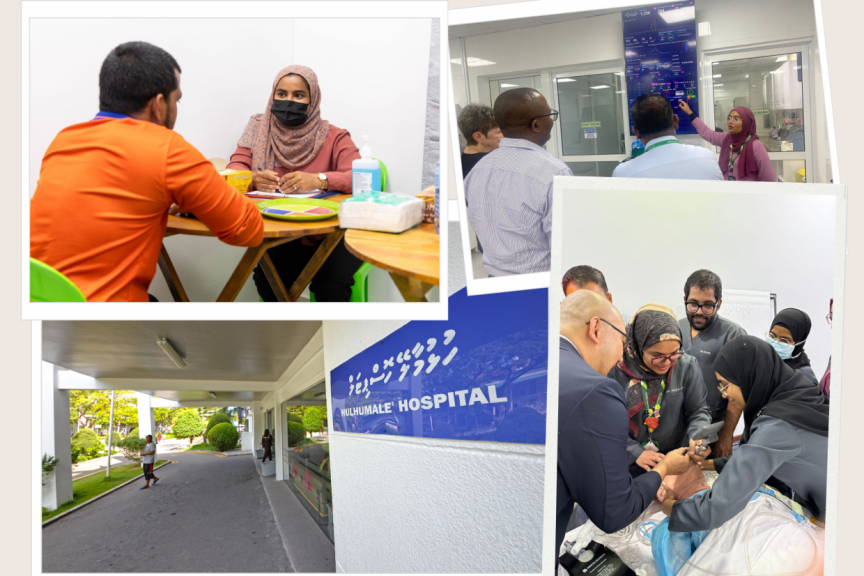
The entire hospital is operating at, or near, full capacity, including both the OPD and the Emergency Room. The effects of this are not only observed from doctors and healthcare assistants but also from administrative staff. The loud noise of complaints from patients echoed through the hospital premises.
This was the experience as an individual who accompanied a patient during a four-hour visit to the Hulhumalé Hospital last night. While the population of Hulhumalé—now densely filled with flats and buildings—has rapidly increased, the only government hospital remains the Hulhumale’ Hospital, which was constructed when people first settled in the suburb. This has become one of the most pressing concerns for residents of Hulhumalé. The fact that the sole primary center for medical treatment is tackling serious congestion raises broader concerns about the healthcare system. The bitter reality of failing to expand essential services in line with the growing population is now becoming increasingly apparent.
The Gap Between Population and Capacity
The population of Hulhumalé is currently estimated at approximately 150,000. According to President Dr. Mohamed Muizzu, when all three phases of Hulhumalé are collectively considered, it is envisioned to accommodate around 300,000 people. However, the capacity of the only government hospital serving this substantial population is smaller than that of the regional hospital in Kulhudhuffushi City.
Despite Hulhumalé being the fastest-growing population center in the Greater Malé Area, the hospital’s capacity has failed to keep up. Hulhumalé Hospital has only 17 ICU beds, and as a result, it remains at full capacity for extended periods as patients seek care. The shortage of sufficiently experienced doctors, limitations of the building, and the absence of additional facilities proportionate to the population are clearly evident.

Patients’ grievances and anxiety among staff
Due to the high volume of patients, the public frequently raises concerns about delays and inadequate access to care. For example, a middle-aged individual who I met Hulhumalé Hospital last night had come to the hospital at 6:30pm in the evening exhibiting symptoms that a biomarker level in the body was significantly elevated. Tests ordered by the doctor confirmed that the level was at a dangerous point. However, by the time the patient was seen, treated, and discharged, it was nearly 12:00am—accounting to roughly five and a half hours of waiting time. Upon leaving and proceeding to the STO pharmacy, the prescribed medication was found to be unavailable.
As a result of such delays, some individuals express their frustration by shouting near the reception area, opening consultation room doors to lodge complaints, and slamming doors. These actions contribute to heightened anxiety among healthcare workers. Nevertheless, even under these circumstances, doctors, nurses, and administrative staff continue to provide services with notable professionalism and kindness. They carry out their duties while enduring significant pressure from patients, highlighting both their heavy workload and the mental and physical strain they experience. The imbalance between the limited number of staff and the high volume of patients is a key factor contributing to the decline in healthcare quality.
While Hulhumalé Phase 2 accommodates thousands of residents, it currently lacks a hospital. As such, in the event of any medical need, all residents must travel to Hulhumalé Hospital in Phase 1. To address this, a GP Clinic has been established in Phase II, offering 24-hour doctor consultation services, and efforts are underway to open additional GP clinics.

However, these GP clinics are not adequately equipped to serve such a large population. Typically, a GP clinic has only one bed for admitting patients. Given the high number of individuals seeking consultations and the limited number of doctors available, situations frequently arise in which a single doctor must attend to numerous patients in a day, resulting in long queues.
This reflects a longstanding systemic issue stemming from the failure to plan essential services in parallel with population growth. Although Phases 2 and 3 were developed after Phase 1, the expansion of essential services did not receive sufficient attention. While large-scale infrastructure projects have been implemented, the lack of forward planning for the healthcare system required by residents represents a significant oversight in the development process.
Efforts seeking a solution
Since the current government assumed office, efforts have been initiated to improve Hulhumalé’s healthcare system. In May of last year, the government announced plans to construct a new 10-story building with a capacity of 250 beds at Hulhumalé Hospital. The Malé City Group of Hospitals has stated that this new facility will include private rooms. Additionally, seven new beds were recently added to the hospital’s Emergency Room, increasing its capacity to 14 beds. Work is also ongoing to develop a new 28-bed ward, which will include a Medical High Dependency Unit and additional pediatric beds.
Despite these developments, current capacity remains far from sufficient to meet demand. Although expansion efforts are in progress, they are relatively limited compared to the rapid pace of population growth. Until these projects are completed, residents are left with little choice but to endure long waiting times.
This situation did not arise suddenly. It is the result of concentrating a large population in one area without adequate prior planning. Incremental improvements alone will not suffice to meet the needs of Hulhumalé’s substantial population. A more comprehensive transformation is required. The current state is inadequate, and urgent measures are needed—particularly the acceleration of the 250-bed hospital project and the establishment of additional, well-equipped healthcare facilities in Phases 2 and 3. Without these changes, a hospital that is already overcrowded will only become more "ill."