date_range
Sunday 06 Sep 2026


 LOCAL EDITION
close
 LOCAL EDITION


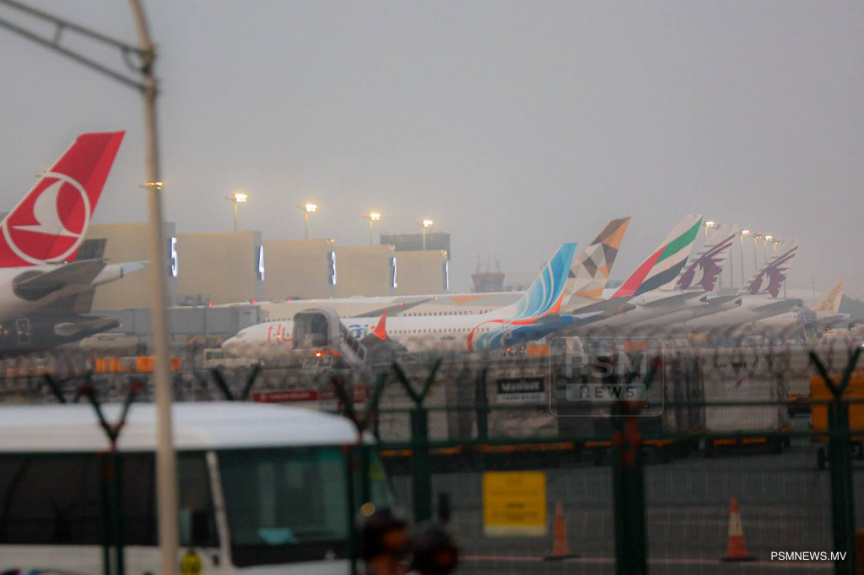
Haze as seen at Velana International Airport (VIA), December 22, 2025. (Photo/PSM)
A number of international flights scheduled to arrive in Maldives on Friday have been cancelled, leaving more than 4,000 passengers unable to travel.
Inner Maldives Managing Director Mohamed Firaq said the cancellations are a serious blow to the country and its economy. He said this is a time for the entire industry to act together and take practical steps instead of pointing fingers.
According to a flight schedule shared by Firaq on social media, several flights operated by major Middle Eastern airlines have been cancelled. These include Emirates, Fly Dubai, Qatar Airways, Etihad Airways, Gulf Air and Air Arabia, the main carriers bringing the highest number of tourists to Maldives.
Five Fly Dubai flights, three Emirates flights and three Qatar Airways flights have been cancelled. In addition, two Air Arabia flights, two Gulf Air flights and one Etihad flight have been cancelled.
The schedule shows that the cancelled flights include both wide‑body aircraft such as Boeing 777 and 787 and narrow‑body aircraft such as Boeing 739 and Airbus A320. This means a significant number of tourists travelling both long‑haul and short‑haul will be unable to arrive.

Firaq noted that with these cancellations, more than 4,000 seats have become vacant, a major drop compared to the average daily tourist arrivals.
Expressing concern over the situation, Firaq said, “This is a serious blow to the country and its economy.”
Maldives’ economy is heavily dependent on tourism. A sudden decline in tourist arrivals has a direct impact on resorts, guesthouses and tour operators.
Tourism is also the main source of foreign exchange for Maldives. The loss of 4,000 tourists in a single day will affect state tax revenue and the service charge earned by resort employees.
“This is not the time to point fingers at each other. This is the time for everyone to act together,” Firaq wrote in his social media post.

He said the entire industry needs to come together and take urgent steps to overcome the situation. His remarks indicate that all stakeholders should sit at the same table instead of aggravating divisions.
Firaq proposed that all industry players work together to enter new markets, even if it requires offering significant discounts.
With global economic shifts and rising competition from other tourism destinations, Firaq said it is no longer possible to rely solely on familiar markets.