date_range
Thursday 03 Sep 2026


 LOCAL EDITION
close
 LOCAL EDITION


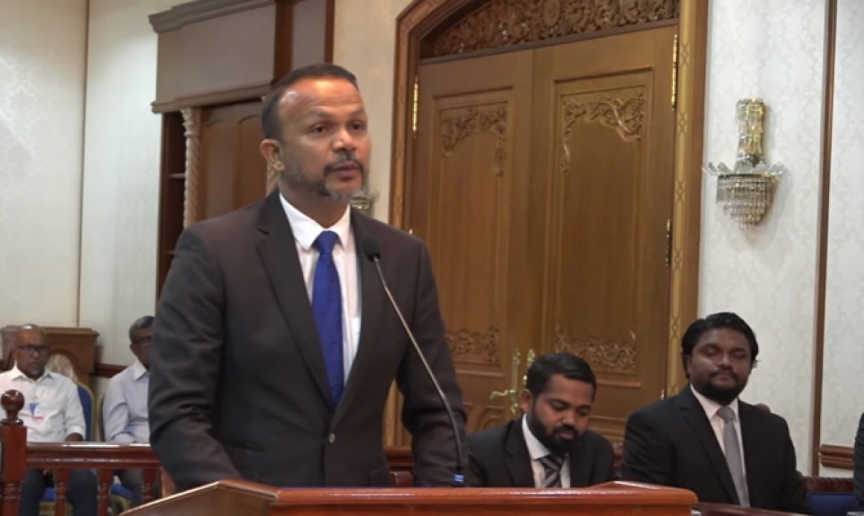
Ali Hussain argues a case at the Supreme Court challenging anti-defection clauses in the Constitution: Cases filed with Supreme Court to nullify law on merging elections, to halt referendum. (Photo/via Supreme Court)
Two constitutional cases were filed with the Supreme Court on Tuesday, seeking to invalidate the bill passed by Parliament to merge the presidential and parliamentary elections and to halt the scheduled public referendum on the matter.
On February 10, the ruling People’s National Congress (PNC) used its supermajority in the Parliament to pass constitutional amendments proposed by the government to hold future presidential elections and parliamentary elections on the same day.
On February 16, President Dr. Mohamed Muizzu decreed that a public referendum on this – as required by law on such matters – would be held on April 4 – the same day as the local council elections.
The first of the two constitutional cases was submitted by lawyers Ibrahim Shiyam and Aik Ahmed Easa, seeking an injunction to stop the referendum currently scheduled concurrently with the local council elections on April 4th.
The second case was filed by prominent lawyer and former Kendhoo MP Ali Hussain. He has requested the court to declare the public referendum unconstitutional and to nullify the bill passed by Parliament to combine the two elections.
In his submission, Ali Hussain highlighted that President Dr. Mohamed Muizzu granted assent to the bill after the 15-day constitutional deadline for ratification had already expired. He argued that since the deadline was missed, the bill should be deemed void.
Furthermore, he contended that the referendum itself is unconstitutional. Ali Hussain asserted that according to the Constitution, a public referendum must be conducted before such a bill is ratified. He noted that the failure to hold the vote within the stipulated ratification period is a primary reason for the vote's invalidity, stating that the process has fallen outside the scope of Article 264 (a) of the Constitution.
The case also questions the validity of the specific question being posed to the public, citing it does not align with the policies set forth in the Constitution.
In this regard, it was highlighted that the presidential decree and the Elections Commission's (EC) announcement frame the question as whether the public favors the ratification of the bill passed by Parliament to merge the elections and redefine the term of the incumbent parliament for the purpose. Ali Hussain argues that the Constitution instead requires the question to ask whether the public consents to the proposed constitutional amendment itself.
He maintains that framing the question around the ratification of a specific bill, rather than the constitutional principle, is outside the bounds of the Constitution.
Notably, opposition Maldivian Democratic Party (MDP) has also filed a case in the Civil Court seeking to halt the referendum. Last Friday, the MDP reported that its submission had been rejected three times, with the court citing different points for amendment on each occasion. The party has urged that the case be registered and heard as an urgent matter.