date_range
Saturday 22 Aug 2026


 LOCAL EDITION
close
 LOCAL EDITION



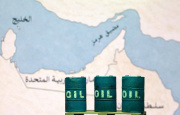
A map showing the Strait of Hormuz and Iran is seen behind a 3D printed oil pipeline in this illustration taken June 22, 2025. (Photo/Reuters)
Oil prices jumped close to 10 percent to above USD 80 a barrel on Sunday after coordinated US and Israeli attacks on Iranian targets triggered fears of a major supply shock across the Middle East.
This marks the sharpest single‑day rise in recent months, driven by escalating military action and growing concern that Iran could retaliate by disrupting traffic through the Strait of Hormuz, the world’s most critical oil chokepoint.
The joint offensive by Washington and Tel Aviv, which killed Iran’s Supreme Leader Ayatollah Ali Khamenei and targeted dozens of military sites, has pushed the region into its most volatile moment in years. Iran has already launched missile and drone attacks across multiple Gulf states, heightening the risk of a broader conflict.
Traders are now bracing for the possibility that Iran could restrict or attempt to close the Strait of Hormuz, a narrow waterway through which roughly 20 percent of global oil supply and a significant share of LNG shipments pass.

Even without a formal blockade, tanker traffic has slowed sharply after unverified radio warnings from Iran’s Revolutionary Guard Corps claiming the strait was “closed.” Several major shipping companies and oil traders have suspended voyages, with vessels idling near the Gulf of Oman as insurers raise risk premiums.
A prolonged disruption could remove 8–10 million barrels per day from the market even after rerouting through Saudi and UAE pipelines, analysts warn, a supply shock large enough to push prices well beyond USD 100.
Energy‑dependent Asian economies, including China, India, Japan and South Korea, are monitoring reserves and preparing contingency plans as they rely heavily on Gulf crude. China alone receives nearly half its oil imports through Hormuz.
OPEC+ is expected to consider a modest production increase to stabilize markets, but analysts say spare capacity is limited outside Saudi Arabia and the UAE, reducing the group’s ability to cushion a major supply shock.
Market experts say Brent could open closer to USD 100 a barrel if the situation worsens or if tanker traffic remains halted. Some banks have flagged tail‑risk scenarios of USD 120–130 oil should the strait face a sustained closure.