date_range
Sunday 25 Oct 2026


 LOCAL EDITION
close
 LOCAL EDITION


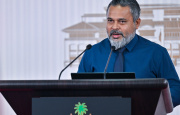
Fisheries Minister Ahmed Shiyam speaks at ceremony to mark Fishermen's Day. (Photo/President's Office)
Fisheries Minister Ahmed Shiyam has responded to former Environment Minister Aminath Shauna’s criticism of the government’s decision to allow oil and mineral exploration under the Special Economic Zone (SEZ) framework.
Shauna had expressed concern over the move, saying it threatens marine biodiversity and undermines the Maldives’ tourism and fisheries sectors. Her remarks followed President Dr. Mohamed Muizzu’s announcement on Tuesday that SEZs would now include provisions for offshore resource exploration.
President Dr. Mohamed Muizzu's strategic plan to diversify the Maldivian economy beyond tourism and fisheries represents a visionary and pragmatic step toward long-term resilience. Our economy is vulnerable to external shocks and by broadening our economic base, we reduce these… https://t.co/KKfqVGOc78
— Ahmed Shiyam (@Shiyamaldives) January 28, 2026
In a post on X, Minister Shiyam defended the decision, describing it as part of a broader strategy to diversify the economy and reduce vulnerability to external shocks.
“President Dr. Mohamed Muizzu's strategic plan to diversify the Maldivian economy beyond tourism and fisheries represents a visionary and pragmatic step toward long-term resilience,” Shiyam wrote.
He noted that the Maldives has one of the world’s largest Exclusive Economic Zones (EEZs), spanning around 900,000 square kilometers, but its use has been limited primarily to tuna fisheries.

“Carefully exploring and developing this vast marine potential opens new avenues for sustainable resource use, partnering only with reputable, capable investors who align with our national interests,” he said.
Shiyam emphasized that any new development would be subject to rigorous, transparent environmental impact assessments, with no compromise on biodiversity or sustainability.
“Economically, this diversification fosters innovation and positions the Maldives as a hub for emerging opportunities in the blue economy,” he added. “It will generate high-quality, skilled employment in specialized fields such as marine geology, subsea engineering, environmental science, and monitoring.”
He concluded that maintaining the status quo is not viable and that the Maldives must proactively strengthen its economic resilience to secure a self-reliant future.
Shauna, meanwhile, reiterated that many countries have reversed similar decisions after witnessing the negative impact of oil and mineral exploration on fisheries and marine ecosystems. She warned that such activities could severely damage the Maldives’ tourism and fishing industries, which are vital to the national economy.