date_range
Friday 23 Oct 2026


 LOCAL EDITION
close
 LOCAL EDITION


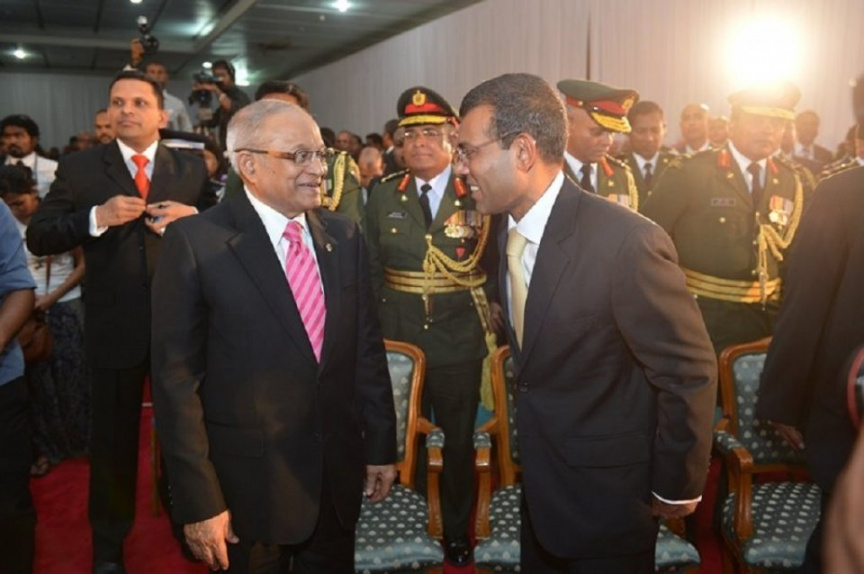
Former presidents Mohamed Nasheed (R) and Maumoon Abdul Gayyoom (L): Nasheed compares dissent during Maumoon's administration who were labelled as backed by Christians to the current situation in Iran.
Former president Mohamed Nasheed has again criticized the Iranian government, citing the situation reminds him of Maldives’ past when former president Maumoon Abdul Gayyoom alleged that activists who protested against his administration were backed by Christian missionaries.
Nasheed, via a post on X on Sunday, called on Muslims and the international community stand with Iranian people who are taking to the streets instead of protecting the regime.
Iranians are taking to the streets demanding dignity and relief from crushing cost of living and decades of repression. They are our Muslim sisters and brothers. The Muslims and the wider international community must stand with the Iranian people, and not protect the regime.
— Mohamed Nasheed (@MohamedNasheed) January 11, 2026
The current protests in Iran stem from the crushing cost of living and other long‑standing public grievances. However, Iranian leaders, including Supreme Leader Ayatollah Ali Khamenei and President Masoud Pezeshkian, have accused Israel and the United States of fueling the unrest.
Hence, Nasheed’s remarks met with stark criticism from the Iranian government. In this regard, the Embassy of Iran in Sri Lanka responded to Nasheed’s post on X on Monday, questioning which side he stands with.
In the continuation of the 12-day war in June 2025, the Iranian nation witnessed a comprehensive military assault by the Zionist regime against cities, civilians, and urban infrastructure, as well as the targeted assassination of Iranian citizens. As a result, more than one…
— Embassy of I.R. Iran in Sri Lanka (@IRANinSriLanka) January 12, 2026
The Embassy emphasized that during the 12-day war in June 2025, the Iranian nation faced a large-scale military assault by the Zionist regime targeting cities, civilians, and urban infrastructure, resulting in the deaths of over one thousand Iranians, including men, women, and children.
It added that Iranian people’s resistance to the cruel attacks by the Zionist regime, combined with direct support from the United States, contributed to a further escalation that threatened public safety and created chaos in the streets of Iran.
The Embassy noted that this time, Iranian children, women, and other innocent civilians became victims of urban terrorist acts carried out by elements linked to Mossad.
It further highlighted that mosques were set ablaze, hospitals destroyed, civilians attacked in streets and marketplaces, and metro stations and banks damaged.
Nasheed responded to the statement on Tuesday, citing he also concurs with having no intervention by the United States in Iran. However, he reiterated his support for the young protesters on the streets, adding it reminds him Maldives’ past when former president Maumoon Abdul Gayyoom alleged that activists who protested against his administration were backed by Christian missionaries.
“We know the real pain is the torture and beatings they faced. Solidarity with Iran's youth fighting for their rights,” he added.
I agree, no to US intervention in Iran. But let's support those young protesters on the streets. Reminds me of Maldives' past – when activists protested against President Gayoom, he'd claim they were backed by Christian missionaries ????. We know the real pain is the torture and…
— Mohamed Nasheed (@MohamedNasheed) January 13, 2026
Dissent against Maumoon’s administration intensified in early 2000s. Back then, senior officials from the administration claimed that the dissidents were funded by Christan missionaries.
Maumoon’s 30-year-long administration came to an end following the election of Nasheed in Maldives’ first democratic election under a newly formed constitution.
However, Nasheed’s administration was short-lived, with the former president resigning just three years into office following mass protests.
The ongoing protests in Iran was initially triggered by frustration over severe economic problems, including soaring inflation, a collapsing currency, rising costs for basics like food and fuel, and broader hardships linked to international sanctions and economic mismanagement.
While economic grievances were the initial catalyst, the protests expanded into wider political expression. Many demonstrators began voicing dissatisfaction not just with economic conditions but with the broader leadership and governance, including calls for political change.
What began as demonstrations in Tehran — especially among bazaar merchants and small business owners — quickly spread to other cities and provinces, reflecting deep public discontent with living conditions and government policies.
Iranian authorities have responded with security crackdowns, arrests, and restrictions on communications — including internet blackouts and phone network disruptions — aimed at limiting the flow of information.
US officials, including President Donald Trump, publicly expressed support for the rights of Iranian citizens to protest and urged the Iranian government to respect those rights and avoid using excessive force. Trump has suggested that the US might intervene if peaceful demonstrators were killed or if violence escalated, describing possible “strong options”, suggesting military intervention.
Iranian authorities, including Foreign Minister Abbas Araghchi, have asserted that the unrest has gone beyond ordinary protests and has been exploited or infiltrated by armed or organized groups they label as terrorists, allegedly supported by the US and Israel. They claim that these individuals attacked Iranian police with knives or other sharp weapons and vandalized public and private property, including mosques, homes, and vehicles, some of which were set on fire.
According to Tehran, these actions are intended to overthrow Iran’s current government and install an administration in the Islamic Republic that is a puppet to the US, with the goals of dismantling Iran's nuclear program and gaining access to its oil, gas, gold, and other natural resources