date_range
Monday 26 Oct 2026


 LOCAL EDITION
close
 LOCAL EDITION


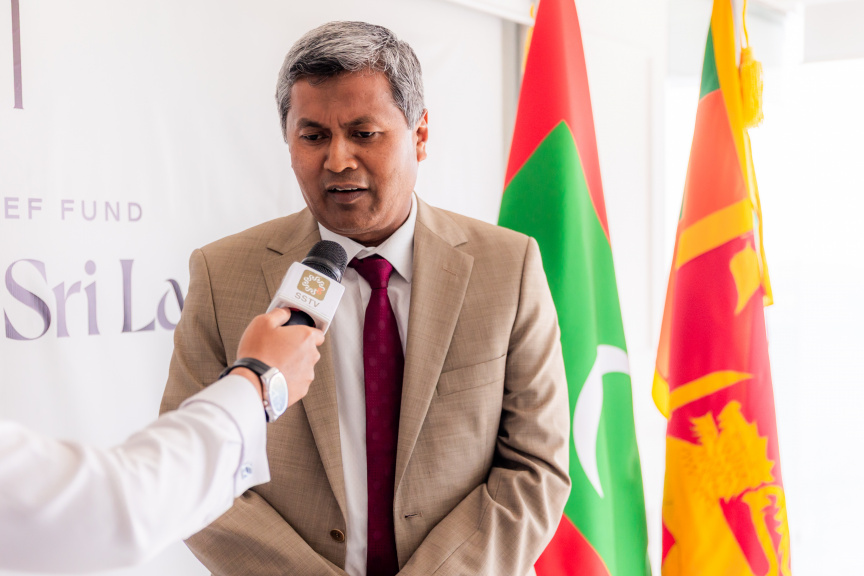
Sri Lanka’s High Commissioner to the Maldives, Mohamed Rizvi Hassen speaks to Sun media at the ceremony held to deliver on Sun Siyam Group's relief aid pledge to Sri Lanka, December 17, 2025. (Sun Photo/Moosa Nadheem)
Sri Lanka’s High Commissioner to the Maldives, Mohamed Rizvi Hassen, has described Sun Siyam Group founder Ahmed Siyam Mohamed’s donation to Sri Lanka as the largest aid contribution made by a single individual.
Siyam spearheaded a special fundraising campaign across all Sun Siyam resorts and companies following the devastation caused by cyclone Ditwah in mid‑November. Alongside contributions from employees, Siyam personally pledged USD 200,000, of which USD 75,000 was handed over last month.
At a ceremony held Wednesday at Sun Siyam headquarters, the High Commissioner received the collective donations: USD 101,701 raised by resorts and companies, plus Siyam’s remaining USD 125,000, bringing the total to USD 301,701.
Speaking at the ceremony, the High Commissioner praised Siyam’s generosity:
“His name will be written in golden letters in our relations and in our corporate world. Now Siyam is a very popular personality in Sri Lanka.”

He noted that Siyam was among the first businessmen to take the initiative to help Sri Lanka, inspiring other businesses worldwide to follow suit.
“His name will be ever remembered in Sri Lanka,” the High Commissioner said, extending special thanks to Siyam and the Sun Siyam Group employees.
He added that the funds were collected in just two weeks, calling it a “huge amount” when converted into Sri Lankan currency, vital for rebuilding efforts.
The High Commissioner further highlighted that Maldives has become an icon in Sri Lanka, with total aid from the Maldives, including government, public, and business contributions, exceeding USD 2 million.

“Even the big players, our neighbours and regional partners, when you see their contribution and the Maldives’, with the people, the public and the government, and magnates like Mr. Siyam, this is the biggest.”
Cyclone Ditwah displaced hundreds of thousands in Sri Lanka and severely damaged infrastructure, compounding the country’s ongoing economic crisis.