
date_range
Friday 20 Nov 2026


 LOCAL EDITION
close
 LOCAL EDITION


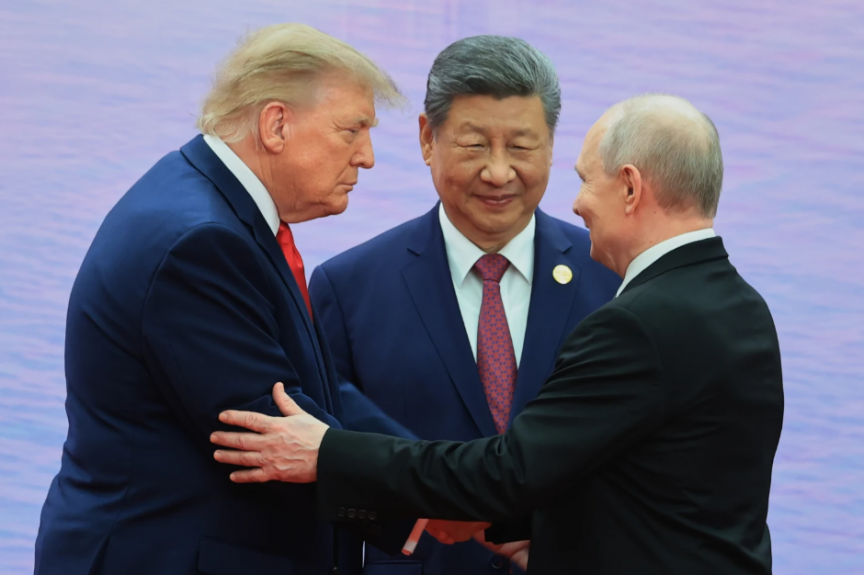
China’s President Xi Jinping, center, stands as US President Donald Trump, left, and Russian President Vladimir Putin shake hands before the welcome banquet at the APEC summit in Shenzhen in southern China’s Guangdong Province, Wednesday, November 18, 2026. (Ding Lin/Xinhua via AP)
The first-ever historic trilateral meeting among the top leaders of the world's three most influential nations—China, Russia, and the United States—was held on today in Shenzhen, China.
Chinese President Xi Jinping described the meeting, attended alongside Russian President Vladimir Putin and US President Donald Trump, as a "historic and groundbreaking" milestone.
The meeting took place on the sidelines of the Asia-Pacific Economic Cooperation (APEC) Summit, which comprises leaders and representatives from 21 economies, focusing on key discussions regarding trade, investment, and regional economic cooperation.
Opening the meeting, President Xi stated that this gathering in Shenzhen marks the first time the top leaders of the three nations have sat down together, noting that their discussions will primarily focus on safeguarding world peace and promoting strategic stability among major powers.
Reflecting on past global events, Xi noted that the two World Wars brought unprecedented devastation to human society. Highlighting that more than 60 regional conflicts around the world remain unresolved and continue to rage today, he stated that history has taught that when major powers cooperate, the world enjoys peace and stability, but when they engage in confrontation, the world descends into turmoil.
Recalling that more than 80 years ago, the three countries joined together in victory as the main forces in the global fight against fascism, Xi added that history is the best textbook, and that they must remember history, learn from its lessons, and shape the future.
Bringing together the leaders of the world’s three major nuclear powers and top economies, the talks are expected to widely cover international trade, advanced technology, the situations in Iran and Ukraine, as well as nuclear arms control.