date_range
Tuesday 10 Nov 2026


 LOCAL EDITION
close
 LOCAL EDITION


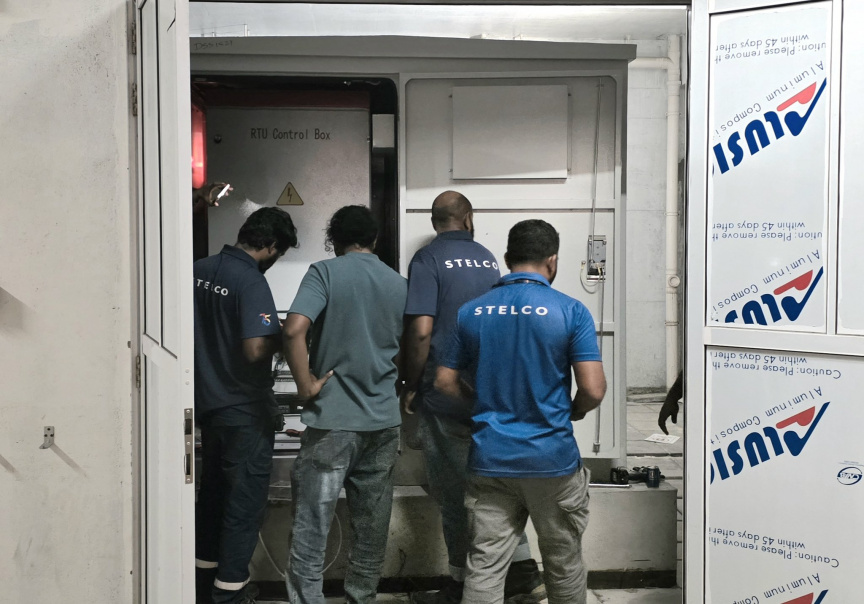
STELCO staff at work: Auditor General warns against large sums paid to SOEs outside budget, urging to reduce expenditure. (Photo/STELCO)
Auditor General Hussain Niyazy, on Tuesday, stated that the share of the state budget allocated to cover the recurrent expenditure of State-Owned Enterprises (SOEs) has increased significantly, with substantial funds being disbursed throughout the year even to companies for which no budgetary allocations had been made.
The Auditor General's Office, on Tuesday, released its professional opinion and technical report on the proposed state budget for the upcoming year.
According to statistics included in the report, expenditure on SOEs amounted to MVR 2.87 billion in 2022 and MVR 4.1 billion in 2023, before rising to MVR 6.8 billion last year. The data further shows that MVR 2.46 billion has been spent on SOEs so far this year, while MVR 2.2 billion is projected for the next fiscal year.
The trend in budgetary support for SOEs indicates an annual increase of several hundred million rufiyaa.
The Auditor General noted that a significant portion of the funds provided to SOEs as capital injections in recent years had actually been used to cover their recurrent expenses. He further highlighted that substantial amounts had been disbursed during the year to companies that were not included in the initial budget for capital injections.
Additionally, the Auditor General pointed out that disbursements to SOEs have consistently exceeded budgeted amounts. Last year alone, capital expenditure exceeded the budgeted allocation by MVR 1.84 million.
"Data provided by the Finance Ministry reveals that by the end of 2023, a total of MVR 4,317 million was owed in dividends, and MVR 4,997 million remained outstanding as unrecovered loan repayments," the Auditor General noted.
In light of these findings, the Auditor General stressed the urgent need to reduce expenditure on SOEs and transform them into entities capable of operating sustainably without state subsidies. He emphasised that strengthening governance and operational policies is essential to ensuring their financial independence.
Specifically, he recommended merging companies with overlapping functions and "right-sizing" their workforces to reduce expenditure. He also advised identifying areas where operational costs could be lowered and developing action plans to implement the proposed savings.
The Auditor General underscored the importance of implementing these reforms as swiftly as possible.
With more than 30 state-owned enterprises in operation, the fact that many are running at a loss places a considerable burden on the state. The combined workforce of these companies has exceeded 41,000 employees, requiring continuous budgetary support. Although the current administration initially decided to dissolve or merge certain companies to reduce costs, new state-owned entities have since been established. Concerns have also been raised over large-scale recruitment by SOEs during election periods.
It is noteworthy that successive administrations have faced allegations of corruption within state-owned enterprises. However, significant public concern remains over the failure to recover lost funds, the lack of thorough investigations and the absence of effective solutions to these longstanding issues.