
date_range
Monday 09 Nov 2026


 LOCAL EDITION
close
 LOCAL EDITION


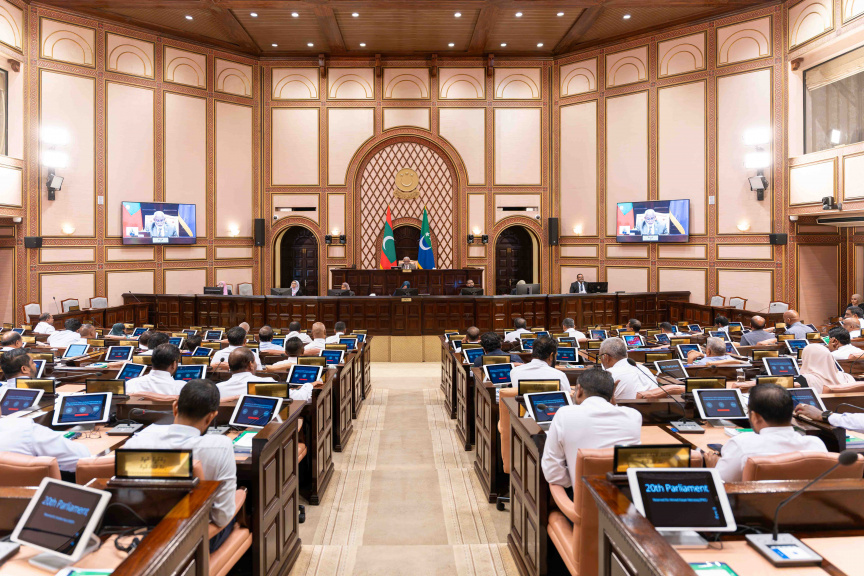
Speaker Abdul Raheem Abdulla presides over a parliamentary sitting on August 18, 2026. (Photo/People's Majlis)
The government introduced a bill to enforce the death penalty in the Maldives on Monday, declaring execution by hanging as the sole method of capital punishment.
The bill, sponsored by ruling People’s National Congress (PNC) lawmaker Hannan Mohamed Rasheed, declares its purpose as establishing a legal framework that sets down the procedure for enforcing the death penalty, in line with the Maldivian constitution, international standards and rights of the public and criminals.
The bill stipulates that the death penalty must be issued after an open trial conducted over an appropriate period of time by an independent and autonomous court of law, and that the Supreme Court must thoroughly examine the case to ensure all legal requirements are met before upholding a death penalty.
The bill also states that a death penalty may be issued only if all of the victim’s heirs agree to it at court.
The bill also lists circumstances where the enforcement of the death penalty may be postponed, this includes if death row convicts appeal it or file for a postponement of execution. The bill states that the enforcement of the death penalty pay be postponed if the mental and physical health of convicts are deemed to have deteriorated, but only until they recover.
And in the case of pregnant death row convicts, the enforcement of death penalty will be postponed until they give birth and their child reaches two years of age.
The bill establishes the sole method of capital punishment in the Maldives as execution by hanging.
It also states that the execution must be carried out behind closed doors, and prohibits recording or disseminating any audio or images of the execution.
The bill states that the execution must be overseen by a seven-member panel composed of an officer of the Maldives Correctional Service appointed by the Commissioner of Prisons, a police officer appointed by the Commissioner of Police, a prosecutor appointed by the Prosecutor General, a lawmaker selected by the Parliament, a doctor selected by the Medical and Dental Council, a representative from the Supreme Court and a religious scholar selected by the Fatwa Council.
The bill states that the convict, their family, lawyers, Maldives Correctional Service and the heirs of the victim must be notified 72 hours ahead of the execution.
The Maldives has maintained a de facto moratorium on the death penalty since 1954.
But in 2023, President Dr. Mohamed Muizzu’s administration announced plans to reinstate the death penalty, following a similar attempt made during former President Abdulla Yameen Abdul Gayoom’s administration.
And in March, President Muizzu announced that the Attorney General’s Office was close to completing drafting a bill to enforce the death penalty.
In July, Yameen, who had pushed to lift the moratorium during his administration, said he was against the move, alleging that incumbent Maldivian judges lack impartiality.


