date_range
Tuesday 20 Oct 2026


 LOCAL EDITION
close
 LOCAL EDITION


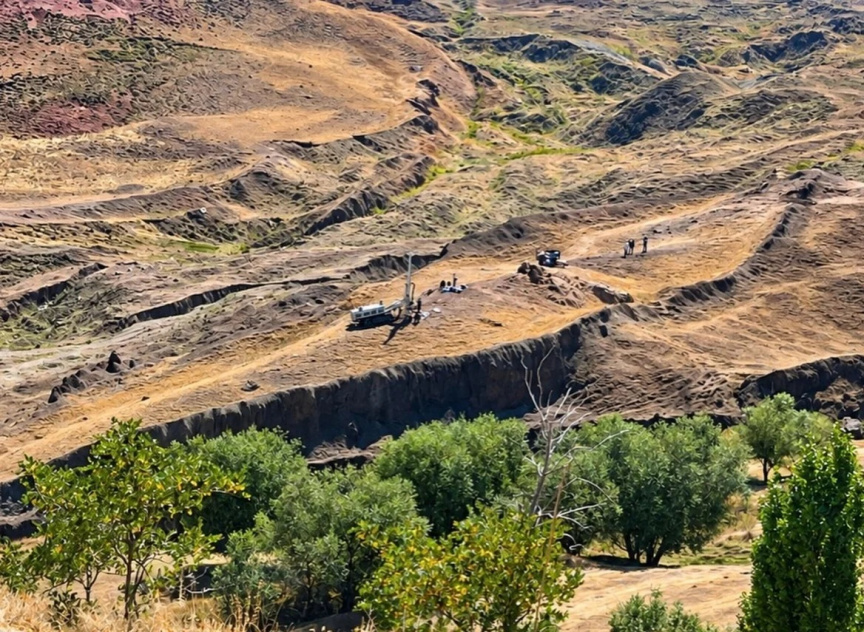
A team of researchers investigating a boat-shaped mound near Mount Ararat in Turkey, which could possibly be the remains of Noah's Ark, September 25, 2026. (Photo/Noah's Ark Scans)
Fresh global buzz has erupted over claims that Noah’s Ark may have been uncovered in eastern Turkiye, where researchers are carrying out new drilling and underground surveys at the Durupinar Formation, a boat-shaped structure long linked to Ark theories.
Viral videos, celebrity visits and sensational headlines have amplified the impression that a breakthrough is close, even though the scientific process remains cautious and far from conclusive.
Recent fieldwork has produced a mix of intriguing but ambiguous results.
Some of the underground scans show right-angle intersections and geometric lines, which researchers say could resemble internal compartments. A 70-meter tunnel-like cavity has also been detected inside the formation.
Soil samples from the site reportedly contain higher carbon content than surrounding areas, prompting speculation about organic material such as petrified wood. During one drill attempt, a drill bit shattered on an extremely hard layer, which some observers interpreted as fossilized timber, though this remains unverified.
A small robot lowered into boreholes has returned early footage showing soil, rock and voids, but nothing that clearly resembles preserved ship structure. Pottery fragments found near the site have also fueled speculation, but their age and relevance are still unknown.
Despite the excitement, no scientific body has declared the Ark discovered.
Experts say the evidence so far is not enough to confirm a man-made vessel, let alone one tied to a specific ancient narrative. They point out that:
the region’s geology can naturally produce boat-like formations
no identifiable ship timbers or joinery have been found
no dating results have been published
none of the findings have undergone peer-review
media claims of “100% confirmation” come from non-scientific sources
Huge Update from the Noah’s Ark 2026 Scientific Expedition: Shallow drilling has officially begun today, and it has been a VERY exciting day.
— Noahs Ark Scans (@noahsarkscans) August 27, 2026
We are carefully drilling down 2 meters and will be collecting over 1,400 samples across the area including in the ark formation.… pic.twitter.com/NnhTvHxDXn
Researchers say they need clear structural remains, reliable dating and contextual evidence before any official conclusion can be made.
For thousands of years, the story of a ship on a mountain lived only in scripture, memory and faith. Today, for the first time, science is brushing its fingers against the edges of that story, not to prove one belief over another, but to remind us that some tales endure because they carry a truth deeper than geography.
The Bible says the Ark rested “upon the mountains of Ararat,” referring to a broad region in eastern Turkiye, just miles from the borders of Armenia and Iran.
The Qur’an, in Surah Hud (11:44), says the ship came to rest on al-Judi, located in southeastern Turkiye near the borders of Syria and Iraq, roughly 200 miles south of Mount Ararat.
Whether the Ark rested on Judi, Ararat or somewhere still hidden, the possibility that a real vessel once survived a real flood is enough to make the ancient world feel suddenly close again, and to understand why the Ark is described as a lasting “sign for the worlds” in the Qur’an.
Watching the world chase the idea of an ancient ship buried in stone, it is hard not to think of the Maldives too, a country dotted with unexcavated mounds and forgotten sites that may hold their own stories from long before Islam arrived. Places where older civilizations once stood, now walked over without a second thought. Would excavating our past help us understand our nature better, or would it open a Pandora’s box we are not prepared to face?