date_range
Tuesday 27 Oct 2026


 LOCAL EDITION
close
 LOCAL EDITION


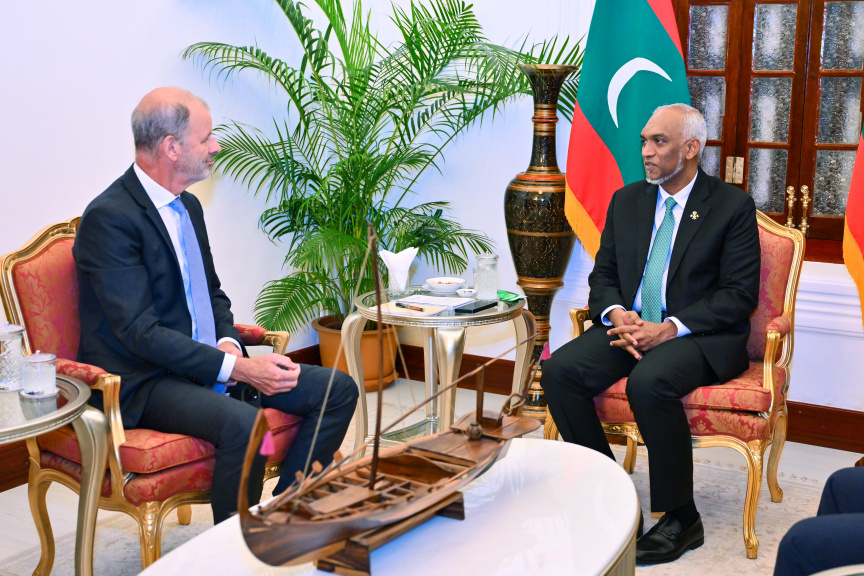
World Bank's Regional Vice President for South Asia, Johannes Zutt (L) calls on President Dr. Mohamed Muizzu (R) on September 16, 2026. (Photo/President's Office)
The Maldives and World Bank engaged in discussions on Wednesday regarding expanding renewable energy to tackle the island nation’s high spending on fuel imports, as the Middle East conflict continues to drive a surge in global prices.
The discussions took place on Wednesday morning during a courtesy call by Johannes Zutt, Regional Vice President for South Asia at the World Bank, on President Dr. Mohamed Muizzu at his official residence, Mulee’aage.
According to a statement released by the President’s Office, President Muizzu expressed appreciation for the World Bank’s continued support to the Maldives and discussed his administration’s development priorities, including digitalization and strengthening the energy sector.
He highlighted the importance of continued partnership in advancing these priorities and supporting the country’s broader development goals.

According to the President’s Office, the discussions focused on expanding renewable energy as part of efforts to reduce the country’s dependence on imported fossil fuel and lower the expenditure on fuel imports.
The discussion highlighted the need for affordable, reliable and sustainable energy solutions and the potential for greater cooperation in this area, said the President’s Office.
The discussions also covered opportunities for continued support in the health sector and advancing the development goals of the Maldives.
During the meeting, President Muizzu underscored the importance of reducing expenditure while ensuring that development efforts remain sustainable and responsive to the country’s long-term needs.
He also reiterated his administration’s commitment to supporting ongoing and future development projects, noting the important role of the private sector in complementing these efforts.
According to the President’s Office, Zutt reaffirmed the World Bank’s readiness to support the Maldives in areas where it can provide assistance, and noted the potential of renewable energy to reduce the country’s dependence on imported fuel and associated vulnerabilities.

The Maldives imports 100 percent of its fuel, primarily diesel and petrol from the Middle East.
In the small island nation, the Middle East conflict has driven up fuel prices and cut tourist arrivals, limiting the government’s ability to finance fuel imports.
The World Bank extended an emergency assistance loan of USD 50 million to the Maldives back in May to support fuel imports.
Information released by the Environment Ministry back in May shows the Middle East conflict has driven the cost of the country’s monthly fuel imports from USD 50 million to USD 116 million – marking an increase of 132 percent.
The country needs 8,000 barrels of diesel daily or around 2.9 million barrels yearly to produce electricity.
The small island nation spent around MVR 10 million on fuel imports last year alone.