date_range
Tuesday 06 Oct 2026


 LOCAL EDITION
close
 LOCAL EDITION


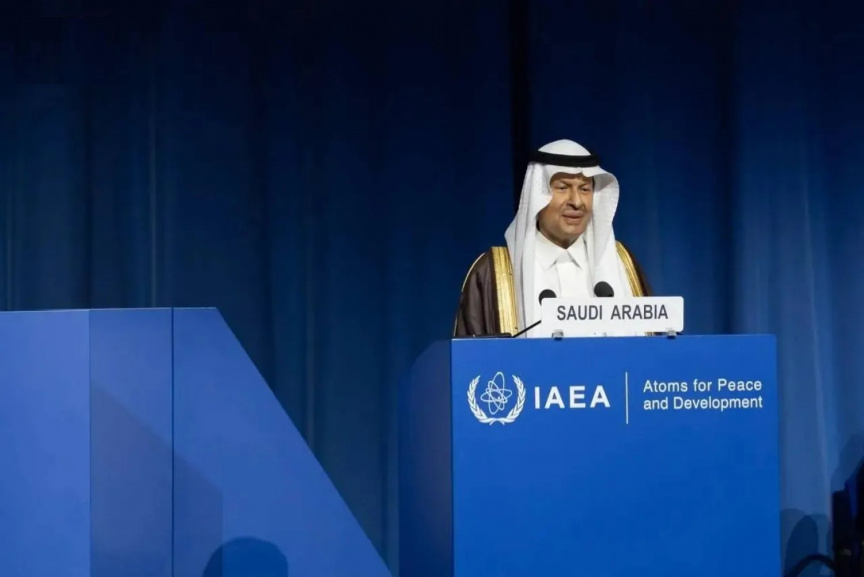
Saudi Minister of Energy, Minister of Industry and Mineral Resources Prince Abdulaziz bin Salman Al Saud speaks at the IAEA conference in Vienna on September 7, 2026. (Photo/SPA)
Saudi Arabia’s announcement of a massive uranium-bearing ore discovery in the Jabal Sayid region has drawn global attention, not only for its strategic value but also for its historical significance.
The discovery was formally revealed by Energy Minister Prince Abdulaziz bin Salman during the International Atomic Energy Agency conference in Vienna last week, marking one of the kingdom’s most consequential mineral announcements in recent years.
Jabal Sayid lies deep within the western Arabian Shield, a vast expanse of ancient rock formations that make up some of the oldest geological structures in the region. The area has been mined for minerals for thousands of years; archaeological studies show evidence of organized copper extraction dating back more than 3,000 years.

What today appears as a quiet stretch of rugged terrain was once part of a thriving Bronze Age mining corridor, where early communities dug, smelted and traded metals long before the rise of modern states. It is within this historically rich landscape, shaped by millennia of mineral activity, that Saudi Arabia has now identified a new and strategically significant resource.
Saudi officials clarified that the find consists of over 110 million tonnes of uranium-bearing ore, not 110 million tonnes of uranium itself. The ore contains rare earth minerals and promising concentrations of uranium, and feasibility studies are underway to determine how much of it can be economically extracted.
The discovery comes at a time when Saudi Arabia has consolidated full ownership of Aramco, strengthening state control over its energy future. Analysts say the find could accelerate Riyadh’s shift from oil dependency to a diversified energy portfolio that includes nuclear power and rare-earth minerals.

If commercially viable, the uranium could support decades of electricity generation. Even modest extraction rates would allow Saudi Arabia to fuel multiple reactors for many years, reducing reliance on imported nuclear material and positioning the kingdom as a regional energy heavyweight.
The announcement also arrives amid heightened tensions with Yemen’s Houthi group, which has carried out missile and drone attacks on Saudi cities. While unrelated to the discovery itself, the geopolitical climate adds weight to Saudi Arabia’s push for strategic self-sufficiency in energy and critical minerals.
For now, Saudi officials say further geological and economic assessments are underway. But the symbolism is clear: a region once known for ancient copper pits may soon become central to one of the Middle East’s most consequential energy transitions.