date_range
Friday 09 Oct 2026


 LOCAL EDITION
close
 LOCAL EDITION


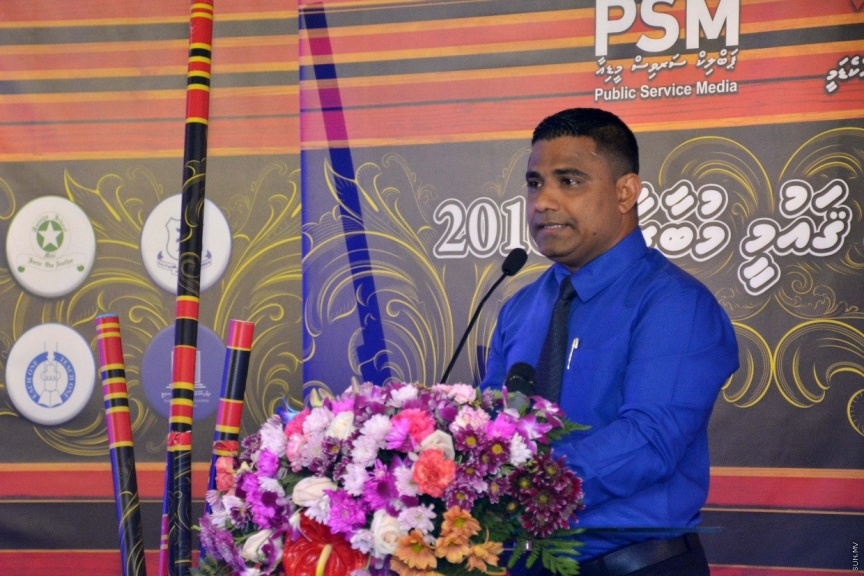
Former President of the Dhivehi Bahuge Academy, Ashraf Ali at the National Oratory and Essay Writing Competition 2016. (Sun Photo/Fayaz Moosa)
The Dhivehi Bahuge Academy celebrates its 15th anniversary today, a significant milestone in the national effort to revive Dhivehi identity and safeguard the mother tongue. Established on August 8, 2011, the institution serves as the state’s official agency entrusted with protecting and promoting the most precious heritage of the Maldivian people.
In an era where languages spoken by small populations face increasing threats of extinction, the role of the Dhivehi Bahuge Academy has become more vital than ever. Over the past 15 years, the Academy has formulated key language rules and regulations and undertaken extensive work to promote Dhivehi through modern technology.
The Academy has carried out numerous national-level initiatives to ensure that Dhivehi remains not only a medium of communication, but also the essence of Maldivian identity and culture. During this period, the Academy has conducted unprecedented research in the history of the language and taken strong steps to preserve its richness for future generations.

The Dhivehi Bahuge Academy was established under Act No. 9/2011 (Priority of the National Language of Dhivehi Raajje Act). Its primary objective is to protect, maintain and develop Dhivehi language, literature, history and literary heritage. The Act highlights global concerns raised by the United Nations regarding the extinction of minority languages. UNESCO emphasizes the right of communities to preserve and transmit their languages to future generations. In this context, the Academy was established to enrich Dhivehi and ensure its priority in official transactions and within the education system. The Academy is also legally mandated to expand the Dhivehi vocabulary and update language rules. Under the Act, it is empowered to review the priority given to Dhivehi by government agencies and issue recommendations to correct violations of language standards. The Academy’s vision is to be the most reliable and authoritative national institution on Dhivehi language, literature and history.
Over the past 15 years, the Academy has been led by distinguished individuals who have contributed significantly to Dhivehi language and literature. Ashraf Ali was appointed as the first president of the Academy and served two consecutive terms. He laid the foundation of the institution and played a key role in formulating language rules. During his tenure, he initiated the drafting of the first two versions of the National Language Policy. On August 8, 2021, Dr Ashraf Abdul Raheem was elected president. Under his leadership, the Academy expanded its use of modern technology and strengthened language appreciation among youth. Dr Ashraf resigned on December 31 last year, and Hassan Shakir Mohamed was appointed president on January 19 this year.
Prominent writers and historians have also served as members of the Academy. Its governing structure consists of five members, including the President and Vice-President. Under their guidance, the Academy has formed specialized committees across various linguistic fields and paved the way for extensive research.

The Academy has published numerous books on Dhivehi language rules and regulations. One of the most notable works is the 2013 publication that cemented the official written form of Dhivehi. The book was later revised and reprinted on May 9, 2024, providing a major solution to inconsistencies in official documents and journalism. In addition, the Academy published a book on the use of Dhivehi letters that enabled the writing of Arabic phonetic sounds in Dhivehi. The modernization of the Dhivehi Dictionary (Radheef) as a smartphone application is another major achievement. The application has made it easier for the public to find word meanings, and the Academy has added vocabulary from dialects spoken across the Maldives, resulting in thousands of new entries previously absent from the Radheef.
The Academy has also reprinted important books on Maldivian history and created a conducive environment for language research. It has digitized many works on Dhivehi history and literature and made them available online, providing valuable resources for students and researchers.
To instill love for Dhivehi language and literature among school children and the public, the Academy has organized numerous national-level competitions. These include the National Speaking Competition for the Al-Ustaz Ibrahim Shihab Cup and the National Essay Writing Competition for the Al-Ustaz Mohamed Jameel Didi Cup. The national short story competition for the Sheikh Malin Moosa Maafaikaleyfaanu Trophy and the national poetry competition for the Huiy Ali Didi Trophy are also notable events. Statistics show that in 2023 and 2024 alone, more than 3,000 students participated in the Academy’s literary competitions. A total of 2,881 participants competed in essay writing, short story writing and poetry competitions. The Academy also organizes special activities to mark important days such as Mother Tongue Day and Poets’ Day, including programs to honor writers and encourage the emergence of new authors and poets.

Among the Academy’s major initiatives is the formulation of a national Dhivehi language policy. The policy outlines measures for teaching Dhivehi and protecting dialects within the education system. It also provides short-term courses in Dhivehi language and history for employees of government agencies and companies. The Academy has conducted successful courses in collaboration with the Civil Service Commission and the Maldives Police Service.
To promote Dhivehi in the digital age, the Academy is working to increase Dhivehi content on online platforms and publish linguistic research. Through these efforts, the Academy is taking important steps to secure the future of the Dhivehi language. However, at a time when English continues to dominate modern communication, much work remains to preserve Dhivehi in its original form. The outcomes of ongoing discussions with relevant authorities to strengthen the role of Dhivehi in the national curriculum are expected to be seen in the near future.