
date_range
Tuesday 20 Oct 2026


 LOCAL EDITION
close
 LOCAL EDITION


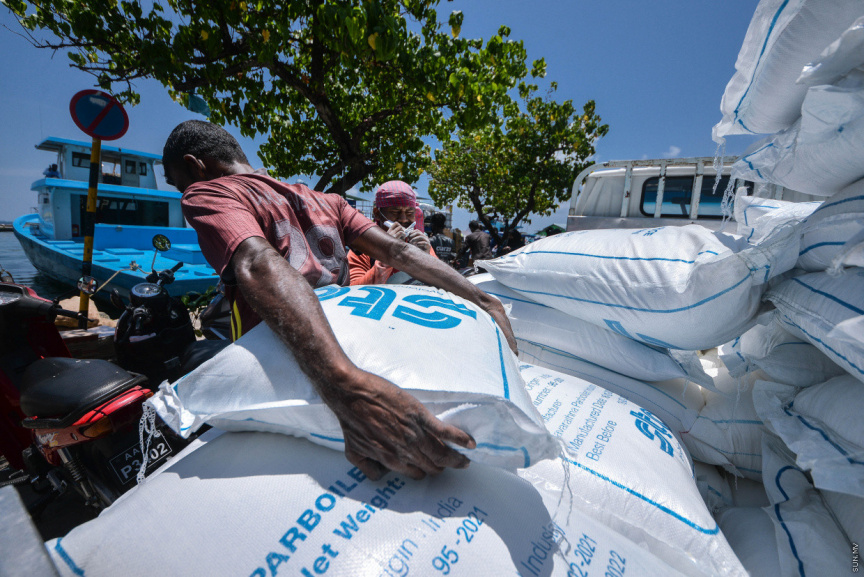
A worker carrying a flour bag in Male' market: ADB has again urged to reduce subsidies and instead, support those most in need via targeted assistance programs. (Sun Photo/Fayaz Moosa)
The Asian Development Bank (ADB) has urged Asian countries, including the Maldives, to reduce spending on expensive subsidy program and instead adopt targeted assistance measures aimed at supporting those most in need.
In its latest Asian Development Outlook report, published on Wednesday, the ADB projected that commodity prices across South Asia would increase more significantly than previously anticipated in its April forecast.
The report estimates that inflation in South Asia will rise to 5.7 percent this year, compared to 2.9 percent in the previous year. In the case of the Maldives, the institution forecasts a 5 percent increase in commodity prices this year, while economic growth is expected to remain constrained at 1 percent.
The ADB noted that, as a country heavily reliant on imported fuel and other essential goods, the price stability experienced in the Maldives during the early part of the year is expected to be replaced by increasing costs in the remaining months.
Prices in the Maldives began rising notably following the outbreak of the conflict involving Iran, with petrol and diesel prices reaching unprecedented levels. Data from the Bureau of Statistics also shows a continued increase in the prices of food products and other essential commodities.

The ADB attributed these developments to disruptions in global supply chains and increased fuel prices driven by the ongoing conflict in the Middle East.
According to the report, higher fuel prices are expected to place additional pressure on government finances across Asia. While subsidies may provide temporary relief to consumers, the ADB cautioned that they can become an unsustainable fiscal burden over the long term, particularly if global fuel prices continue to rise.
The ADB therefore identified the reduction of subsidies on non-renewable fuels as a key measure for strengthening economic resilience and improving preparedness for sudden increases in fuel prices. The institution also highlighted that such reforms would encourage more efficient energy consumption.
To ensure the sustainability of subsidy systems, the ADB recommended directing support towards the most vulnerable households. Possible measures include direct cash transfers and targeted subsidies for public transportation services.
The report further recommends promoting energy conservation by providing fixed discounts on household electricity bills rather than lowering the overall cost per unit of electricity.
The ADB emphasized that such support measures should not become permanent and that additional assistance should gradually be withdrawn once market prices return to stable levels.
Successive Maldivian governments, including the current administration, have announced plans to reform the country’s subsidy framework. The current government’s budget for the previous year included proposals to restructure indirect subsidies—including electricity, fuel, food, and sewerage subsidies—and replace them with a direct assistance system targeting those in need.

However, President Dr. Mohamed Muizzu later decided to suspend the implementation of these reforms to avoid reducing the level of support currently available to citizens.
Following the decision to delay the reforms, state expenditure on fuel subsidies exceeded the allocated budget by 119 percent. In particular, while MVR 379 million had initially been allocated for electricity subsidies, actual spending reached MVR 832 million by the end of the year.
To reduce government expenditure on electricity services, this year’s budget includes measures to expand renewable energy usage and transition from diesel-based power generation to Liquefied Natural Gas (LNG).
According to the budget, shifting electricity generation in the Greater Male’ region to a combination of renewable energy and LNG could eliminate the government’s current expenditure on power generation in the area entirely. The transition is projected to generate savings of MVR 13.9 billion over the next decade.
International financial institutions have repeatedly called for subsidy reforms in the Maldives over recent years, citing concerns over the country’s increasing national debt.


