date_range
Sunday 11 Oct 2026


 LOCAL EDITION
close
 LOCAL EDITION


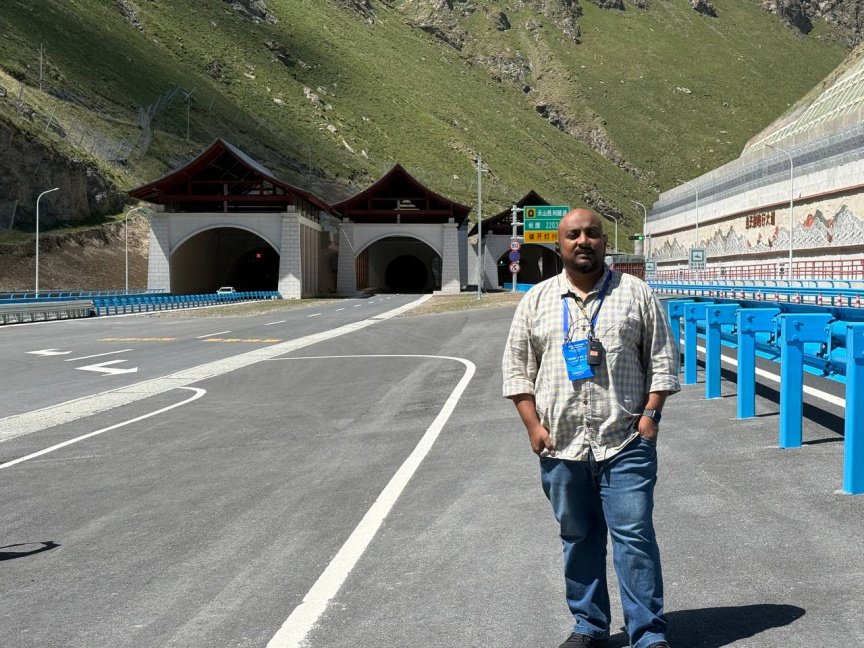
Ahmed Saail Ali tours the Tianshan Victory Tunnel.
When you are a citizen of an island nation like the Maldives, massive engineering projects are almost always envisioned as underwater tunnels or cross-ocean bridges. The Sinamalé Bridge is a perfect example. However, standing in the heart of Eurasia, thousands of miles away from the nearest ocean, I realized that human efforts to forge connections know no bounds. Whether it is a deep sea or massive rocky mountains blanketed in thick snow, this journey proved to me that great engineering can triumph over any obstacle.

I am currently in the Xinjiang Uygur Autonomous Region in northwest China, participating in the "Silk Road Economic Belt Joint Construction Countries Media Head Seminar." Today, alongside senior journalists and editors from around the globe, our destination was a titan of modern infrastructure: the Tianshan Victory Tunnel (Tianshan Shengli Tunnel). Although I had read about projects of this magnitude in the news, catching my first glimpse of the Tianshan Mountains made me realize just how difficult it was to comprehend the sheer scale of this undertaking beforehand.

As soon as our media team arrived, officials walked us through exactly what makes this tunnel an engineering marvel. This is not just a road cutting through a mountain; it is a project that has rewritten the history of civil engineering. The tunnel holds two world records. First, it is the longest highway tunnel on Earth. Stretching across 22.13 kilometers (13.75 miles), it has been certified by Guinness World Records as the longest continuous tunnel excavated from a single borehole. Second, it features the deepest highway shaft in the world. To circulate fresh air so deep inside the mountain, engineers excavated four massive ventilation shafts. The deepest of these plunges down 707 meters—another world record.

For centuries, the Tianshan Mountains stood as a formidable barrier separating northern and southern Xinjiang. Historically, traveling from the northern capital of Urumqi to southern Yuli County (near Korla) meant navigating dangerous, winding mountain passes at altitudes of 4,000 meters. Worse yet, heavy snow and ice closed these roads for up to eight months a year, isolating communities and crippling trade. China built this tunnel to bypass the unpredictable weather and open up a year-round route.

Work on the tunnel—the crown jewel of the entire Urumqi-Yuli Expressway project—began in April 2020. After more than five years of non-stop construction, the tunnel opened to traffic on December 26, 2025. This massive undertaking cost 46.7 billion yuan (approximately $6.6 billion USD), funded by state-owned entities including the Department of Transport of the Xinjiang Uygur Autonomous Region and the China Communications Construction Company (CCCC).

When you look at the subterranean conditions of the Tianshan Mountains, it becomes instantly clear why this project cost billions of dollars. Engineers described drilling through this mountain as entering a "geological hell." Dug up to 1,112 meters beneath the mountain's highest peaks, workers faced extreme underground pressures that triggered sudden rock bursts. Furthermore, the tunnel’s path cuts through 16 distinct fault lines. This meant engineers had to constantly adapt—shifting from drilling through rock-hard granite to dealing with soft mud and sudden, high-pressure water bursts.

To compress what was expected to be a 10-year project into just five, Chinese engineers introduced a innovative "three-tunnel parallel" design. This involved digging a smaller pilot tunnel right between the two main tunnels dedicated to vehicular traffic. Using a custom-built, 280-meter-long Tunnel Boring Machine (TBM), they excavated this central pilot tunnel rapidly. This allowed crews to create side access points into the main tunnels, enabling them to excavate the primary routes from 14 different points simultaneously.

One of the most exclusive opportunities of my trip was visiting the Tianshan Victory Tunnel Monitoring Center. When you are traveling through a 22-kilometer enclosed space, safety measures have to be ironclad. Inside the control room, massive digital screens display real-time footage of every single meter of the tunnel. Officials explained that the facility utilizes a 24-hour hybrid monitoring system that pairs human expertise with Artificial Intelligence (AI).

A network of AI-powered sensors and smart cameras tracks everything from air quality and vehicle speeds to temperature fluctuations and micro-shifts in the mountain's rock face. If a vehicle breaks down, air quality drops, or any anomaly is detected, the AI system flags it instantly. From there, human operators can react within seconds—adjusting the speed of the jet-fan ventilation, updating messages on digital road signs, or dispatching emergency response teams.

The transformation brought about by this project is nothing short of incredible. What used to be an exhausting, hazardous seven-hour journey over the mountains has now been cut down to just 3.5 hours. Even more astonishingly, crossing the Tianshan mountain range itself—which used to require hours of white-knuckle driving—now takes just a safe, smooth 20 minutes.

This is a massive revolution for the people of the region. It slashes logistics costs for industries, secures food supply chains between agricultural hubs, and opens up the breathtaking alpine landscapes of central Xinjiang to tourists safely. Standing near the entrance of the tunnel, watching vehicles disappear into the heart of the mountain, I couldn't help but marvel at human ingenuity. The Tianshan Victory Tunnel is a living testament to what humanity can achieve when we choose innovation over isolation. It is a monument of concrete and steel proving that no mountain is too high, and no valley is too far.
___
Ahmed Saail Ali, reporting from Xinjiang.