date_range
Monday 12 Oct 2026


 LOCAL EDITION
close
 LOCAL EDITION


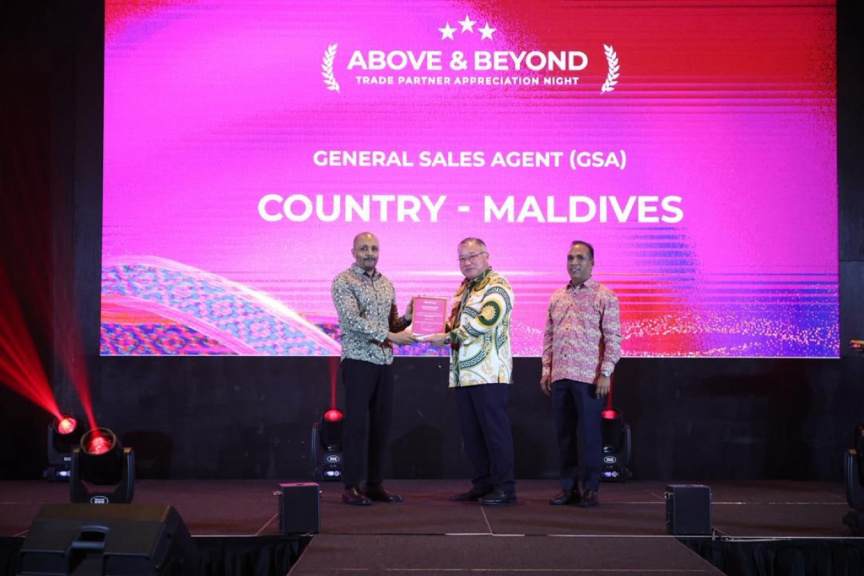
Batik Air handing over letter of appointment as General Sales Agent to Ismail Imran Rushdhee (Imma), the Managing Director of Concierge Group.
Some individuals are remarkably fortunate. From a young age, they are given the opportunity to pursue the exact career they dream of and progress within that field. It is truly a blessing to earn a good income while doing what one loves. Others, when deprived of that direct path, find alternative ways to advance in the industry they are passionate about.
The story of Ismail Imran Rushdhee (Imma), the Managing Director of Concierge Group—a 100% Maldivian company operating in aviation, cargo, and tourism—stands out precisely for this reason.
Imma is the eldest of ten children born to a businessman. During his lifetime, Imma’s father, Abdul Baree Rushdhee of Ma. Kelaavee, operated "Silver Company," a business that provided wide-scale shipping services. Today, Silver Company has evolved into Total Transport Solutions. However, from an early age, Imma’s interests were firmly rooted in aviation and tourism. He always dreamed of becoming a pilot and taking to the skies. Both then and now, all of his passions have remained closely tied to the aviation industry.

However, in this society, working in the family business is often regarded as an obligation for children. As a result, after completing his higher education both in the Maldives and abroad, Imma found himself following that path. Setting aside his dream of becoming a pilot, he joined his father’s shipping company in 2001. When his father passed away while Imma was only around 23 years old, he felt a strong responsibility to continue in the family business. Despite having little passion for the industry and encountering numerous challenges, he continued with the company until 2018. Even as he advanced within the business, the most significant issue Imma observed and experienced was that these sectors in the Maldives were largely dominated by companies from neighboring countries. This dominance extended across aviation, tourism, and many other industries.
After selling his shares in his father’s company, Imma decided to establish his own venture, and his passion naturally led him back to the aviation industry. He traveled frequently to Dubai and several Asian countries, exploring business opportunities within the sector. During this journey in 2018, he met executives from Batik Air, a Malaysian airline, who offered him the opportunity to serve as the General Sales Agent (GSA) for Batik Air as it prepared to commence operations in the Maldives. However, this did not go as planned. Shortly after launching the venture with great optimism, the world was struck by the COVID-19 pandemic prompting Maldives to go on lockdown, which bought the operations to a complete standstill.
During that period, Imma devoted his time to working on various ventures across Dubai, Malaysia, and Thailand. Then, in May 2023, Batik Air decided to resume flights to the Maldives and instructed him to make the necessary arrangements without delay. He was given only two weeks to prepare. There was an enormous amount of work to be completed, including securing office space and recruiting managers and staff for reservations, airport operations, and other functions. Imma assumed responsibility for passenger ticket sales, cargo space allocation, and serving as the airline’s General Supervision Agent at the airport. He confronted all of these challenges with remarkable resilience, supported by many individuals. Initially, he approached several people to join the team, but many were reluctant due to the prevailing uncertainty. Nevertheless, Imma persevered, and his determination ultimately paid off.
"We received immense cooperation from Civil Aviation, MACL, MACL's commercial and slot teams, Aviation Security Command, Customs, and Immigration," Imma said.

Imma launched Concierge Group’s operations as the General Sales Agent for Batik Air in the Maldives with a team of 14 Maldivian employees. It is a highly demanding line of work, involving extensive daily operations ranging from reservations and airport services to cargo logistics. The company must meet the sales targets set by the airline’s head office while simultaneously addressing all customer service requirements. In addition to representing the Malaysian semi-budget carrier Batik Air, Imma’s company has also partnered with Air Arabia Cargo and several other airlines. At present, he is working to bring one of India’s largest airlines to the Maldives, along with another Arab carrier. Imma has also established an airport office capable of serving private jets. Although he never became a pilot, he has finally begun "flying" through the opportunities he created within the aviation industry. However, he remains deeply concerned about the major challenges Maldivians face when attempting to advance in this sector within their own country.
The greatest challenge facing local businesses in this industry is the level of control exercised by entrepreneurs from neighboring countries. Imma stated that although many of these businesses are registered under Maldivian names, they are in fact controlled by foreign nationals.

Imma explained that when foreign companies operate these low-commission, base-rate businesses, it becomes extremely difficult for local companies to compete. One of the greatest obstacles arises when local companies approach airlines to secure a GSA appointment in the Maldives, only to be instructed by the airlines to coordinate instead through a private company based in a neighboring country.
Furthermore, local companies do not benefit from the same operational advantages enjoyed by foreign entities operating in the Maldives. Imma highlighted that while foreign operations typically employ about four expatriate workers at a total cost of approximately $1,000, Maldivian companies pay nearly $1,000 in salary for a single local employee. In addition to higher wages, local companies also provide holidays and other standard employee benefits. Imma emphasized that if foreign entities continue to operate these businesses with such ease and at significantly lower costs, local companies will eventually be forced out of the market altogether.
"If you look at some places, they have the logos of all the airlines plastered on their external walls. In one corner they sell tickets, in another they sell electronics. They even set up money exchange counters, running everything under one roof. There are many such places in Malé. According to Civil Aviation regulations, ticket offices must meet specific standards. Yet, we don't see these standards being maintained in these tiny, makeshift offices," Imma pointed out.

Additionally, Imma noted that under the current environment, these arrangements can easily be exploited as a mechanism for foreign businesses to transfer the revenue they generate in the Maldives back to their home countries. As further evidence of the limited local control over the industry, Imma observed that funds owed to foreign airlines are routed through companies operating in various other countries rather than being remitted directly from the Maldives. He argued that if genuine Maldivian control existed, these funds would instead be transferred directly to the airlines from local accounts.
"These matters have spiraled out of control due to a lack of monitoring"
Imma believes that businesses within the sector, such as airline handling and ticketing, should be legally reserved exclusively for Maldivians, with this policy being strictly enforced. To achieve this, he stated that authorities must monitor and verify whether funds due to airlines are being remitted directly. He further emphasized that foreign participation should be limited to large-scale investments that inject substantial capital into the Maldivian economy.
"Foreigners should absolutely be allowed to do business, foreign employees should work here, and foreign partnerships should be formed. However, foreigners should engage in large-scale investments that bring substantial capital into the Maldivian economy. Because foreign nationals are allowed to operate everyday businesses meant for ordinary citizens, the country is facing a shortage of US dollars," Imma said.

To curb the undue influence of foreign-operated businesses in the Maldives, strong and immediate measures are required. He emphasized the importance of establishing a system that clearly identifies the ultimate beneficial owners of companies, closely monitors foreign currency inflows and outflows, and ensures complete transparency in agreements between foreign and local companies. To facilitate this, he stated that individuals authorized to operate the bank accounts of such businesses must be 100% Maldivian.
"Commission-based businesses must be designated as strictly Maldivian-owned. However, equitable and transparent partnerships that bring in foreign expertise can be exempted. Furthermore, under fair guidelines, incentives through taxes and regulations should be provided to companies that actively employ and support Maldivians," Imma stated.
"We also need to ensure that companies selling tickets through online gateways are actually paying their taxes."
Imma concluded that although Maldivians are capable and hardworking, they are forced to compete under unfair conditions while also facing a high cost of living. He firmly believes that by supporting locally owned Maldivian businesses, the country can build a stronger and more resilient economy.
Today, Imma stands firmly established in the industry he has always loved, equipped with years of valuable experience. He may not be flying as a pilot, but he is undoubtedly soaring in his career. Nevertheless, his foremost concern remains the overwhelming foreign influence within the sector. He believes this trend must be halted, for only then will many more Maldivians like Imma be able to spread their wings in the industry. If left unchecked, Maldivian entrepreneurs risk being driven out of the market entirely, leaving locals with no option but to work as employees for foreign entities within their own country. Imma warned that without a robust government monitoring system, local business owners face a serious risk of becoming marginalized in their own homeland.