date_range
Friday 28 Aug 2026


 LOCAL EDITION
close
 LOCAL EDITION


Protestors hold up signs during an anti-rape rally in Male City: Supreme Court has ruled that interviews of children in sexual abuse cases cannot be access outside of court premises. (Sun Photo/Fayaz Moosa)
The Supreme Court has ruled that video interviews of children conducted during investigations into child sexual abuse cases cannot be accessed by defense lawyers outside court premises.
This ruling follows an appeal in a case where both a lower court and the High Court had permitted the defense to access recorded interviews of children beyond the court setting for evidentiary review. The prosecution subsequently appealed to the Supreme Court after an unsuccessful challenge at the High Court level.
At the High Court, the matter was heard by a bench headed by Dheebanaz Fahumy, with concurring opinions from Mohamed Shaneez Abdulla and Abdul Maaniu Hussain.
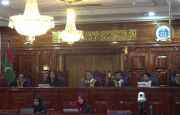
Upon appeal, the Supreme Court—conducting proceedings in closed session to safeguard the interests of the minors involved—unanimously overturned the High Court’s decision. The three-justice bench held that such sensitive video evidence must remain strictly under court custody and cannot be removed.
“In accordance with the Child Rights Protection Act, the responsibility to protect and ensure the rights of children, and to take all necessary measures to that effect, lies with every state institution. The courts are not exempt from this obligation,” the Supreme Court stated in its unanimous judgment delivered on Monday.
Maintaining confidentiality in cases involving child sexual abuse and exploitation has long been a fundamental principle of the criminal justice system. The Prosecutor General’s Office has consistently upheld a policy of not releasing copies of documents containing sensitive information about children. It has further emphasized that, even for the purpose of preparing a legal defense, such materials may only be reviewed within court premises under strictly regulated conditions, in order to prevent any potential disclosure of confidential information relating to child victims.