date_range
Friday 09 Oct 2026


 LOCAL EDITION
close
 LOCAL EDITION


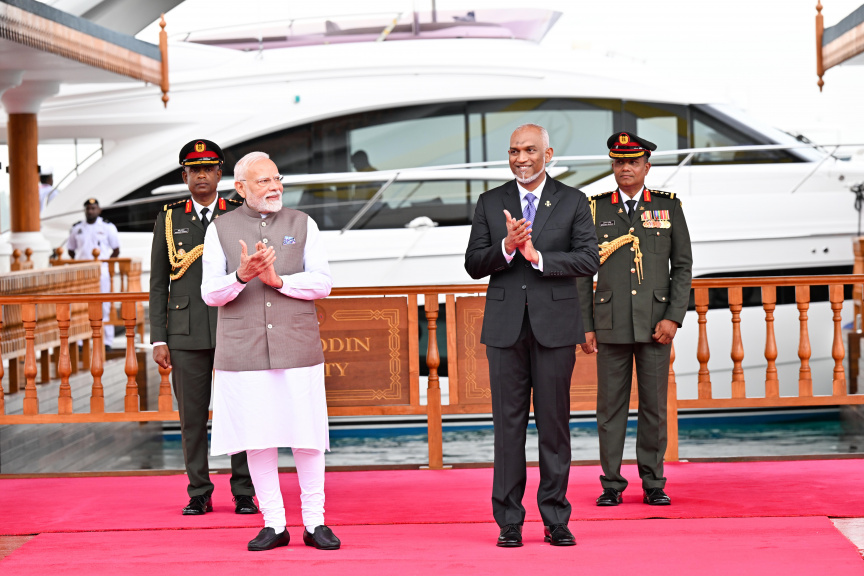
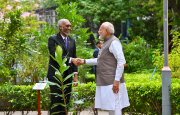
Indian Prime Minister Narendra Modi (L) and Maldivian President Dr. Mohamed Muizzu (R) on July 25, 2025. (Photo/President's Office)
The following is an op-ed by Rishi Suri, the chief editor at The Daily Milap.
---
If there is one word that best defines India Maldives relations, it is proximity. Geographic proximity, economic proximity, and people to people proximity. Over the past few years there have been moments of political turbulence and heated rhetoric, but beneath the headlines the structural reality has remained clear. India continues to be one of Maldives most important development partners, economic supporters, and security collaborators. The next phase of this relationship is not about repair. It is about renewal and expansion.
Trade, supplies, and everyday resilience
Maldives unique geography, spread across small islands, makes it especially dependent on reliable supply chains. In this context India plays a practical and indispensable role. According to the High Commission of India in Malé, bilateral trade crossed 300 million dollars in 2021 for the first time and has since moved beyond 500 million dollars in subsequent years. That growth reflects structural deepening rather than temporary spikes.
India supplies essential goods including food items, construction materials, medicines, machinery, and consumer products. During periods of global supply chain stress and post pandemic recovery, India remained a dependable source. For a country whose economic stability depends heavily on imports and tourism, that reliability is strategic capital.
Greater Malé Connectivity Project: A transformative anchor
The flagship symbol of India Maldives cooperation is the Greater Malé Connectivity Project valued at around 500 million dollars. The package includes a 100-million-dollar grant and a 400-million-dollar line of credit from India. It is the largest infrastructure project undertaken by India in Maldives.

The project will connect Malé with Villingili, Gulhifalhu, and Thilafushi through a 6.74-kilometer bridge and causeway system. This is not just an engineering structure. It is an economic multiplier. By improving connectivity between residential, port, and industrial zones, the project will unlock new housing expansion, logistics efficiency, and private investment opportunities. In a country where land is scarce and urban congestion is real, connectivity directly translates into economic competitiveness.
Water, sanitation, housing, and community impact
Beyond headline projects, India Maldives cooperation has a strong grassroots dimension. Under Indian lines of credit, water and sewerage network projects have been implemented across 28 islands. These projects directly improve public health, environmental standards, and quality of life.
Through High Impact Community Development Projects India has supported facilities for mental health, special education, speech therapy, and street lighting. These initiatives rarely make global headlines, yet they are precisely the kinds of interventions that strengthen social resilience.
In July 2025 official statements highlighted the handover of 3300 social housing units along with the inauguration and progress of multiple development and community initiatives. Housing in Maldives is not a minor issue. It is central to urban stability and long-term planning. India involvement in such projects demonstrates that the partnership extends into the social fabric of the country.
Financial stability and macro support
Trust between nations is often tested during periods of financial strain. In October 2024 the Reserve Bank of India and the Maldives Monetary Authority signed a currency swap agreement that provides Maldives access to up to 400 million dollars and 30 billion Indian rupees until June 2027. This arrangement offers liquidity support and confidence at a time when small economies face global financial volatility.
In July 2025 India also announced a new 565-million-dollar line of credit for Maldives. Such financial commitments underline a long-term approach. These are not symbolic gestures. They are instruments that help sustain development, manage fiscal pressures, and fund infrastructure.
Tourism and people-to-people ties
Indian tourists have historically been among the largest visitor groups to Maldives. In 2023 around 209193 Indian tourists visited Maldives. In 2024 that number declined to about 130805 amid diplomatic tensions. However, Maldives overall tourism numbers remained strong at over 2046615 arrivals in 2024, and the government set a target of attracting 300000 Indian tourists in 2025.

This data reveals two things. First, tourism between the two countries has deep foundations. Second, there is significant scope for revival and expansion. Improved air connectivity, marketing cooperation, and digital payment integration can help restore and grow this segment. Tourism is not just an economic activity. It is the most visible expression of people-to-people bonds.
The future agenda: Digital connectivity, green growth, maritime cooperation
Looking ahead, India Maldives relations can evolve along three clear pathways.
First, connectivity and urban transformation. The Greater Malé Connectivity Project can become a template for additional port, logistics, and urban development initiatives that support Maldives ambition to diversify beyond tourism.
Second, digital public infrastructure. Discussions around cooperation in areas such as digital payments including Unified Payments Interface systems can reduce transaction costs, support small businesses, and facilitate tourism flows.
Third, maritime security and disaster response. As partners in the Indian Ocean region, India and Maldives share interests in search and rescue, humanitarian assistance, disaster relief, and coastal surveillance. Cooperation in these areas strengthens regional stability and reinforces Maldives security architecture.
From reset to relaunch
India Maldives relations are not defined by a single political cycle or temporary disagreement. They are shaped by geography, economics, and shared strategic interests. Over the past few years, the partnership has delivered tangible outcomes. A 500-million-dollar connectivity project. Water and sanitation systems across dozens of islands. Thousands of housing units. Currency swap support. A new 565-million-dollar credit line.
The question therefore is not whether the relationship can survive. It already has. The real question is how ambitious both sides are willing to be.
If India and Maldives align their cooperation around infrastructure, financial stability, digital transformation, green resilience, and maritime security, this partnership can become a model for regional collaboration in the Indian Ocean. The foundations are already in place. The next chapter depends on political will, mutual respect, and a shared vision for prosperity.