date_range
Monday 23 Nov 2026


 LOCAL EDITION
close
 LOCAL EDITION


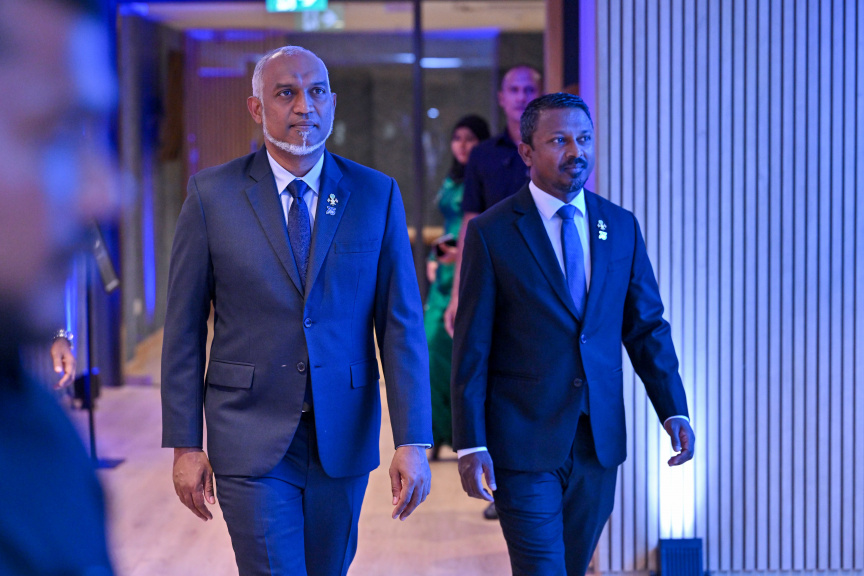
President Dr Mohamed Muizzu (L) with Attorney General Ahmed Usham (R): Attorney General's Office underscores that arguments raised by Maldives supported by ICJ in its historic ruling on Rohingya genocide. (Photo/President's Office)
The International Court of Justice (ICJ), in its landmark ruling on the genocide committed by Myanmar against the Rohingya people, has supported key legal arguments presented by the Maldives in its intervention in the case.
Last Thursday, the ICJ determined that Myanmar had acted with genocidal intent to destroy the Rohingya ethnic group.
In a statement released on Sunday, the Attorney General's Office noted that the Maldives was the first country to announce its intervention in the case as a state party to the Convention on the Prevention and Punishment of the Crime of Genocide (Genocide Convention). Attorney General Ahmed Usham served as the Agent for the Maldives, while the country's legal team included Barrister and Professor Amal Clooney and Barrister and Professor Philippa Webb KC.
The Maldives' submissions in the case emphasized Myanmar's obligation to punish those responsible for genocide and its duty to investigate and prosecute perpetrators before an independent and impartial tribunal.
Press Release: Maldives welcomes landmark ICJ judgment finding Myanmar responsible for genocide against the Rohingya Link: https://t.co/qKlTUt3IMl https://t.co/oSzlcCyAs3
— AG Office Maldives (@AGOmv) November 22, 2026
The Attorney General's Office highlighted that the ICJ's judgment reflected significant legal arguments raised by the Maldives concerning obligations under the Genocide Convention. The Court noted that The Gambia supported the Maldives' position that, once there are reasonable grounds to believe genocide has occurred within a state's territory, it must be investigated promptly, effectively, thoroughly, independently, and in good faith.
Furthermore, the Court upheld the Maldives' submission that proceedings under the Convention must incorporate all elements of a fair trial, and that penalties imposed must be commensurate with the gravity of the crime of genocide and serve as a deterrent against future occurrences. The judgment also took into account the Maldives' advocacy for countries to establish legal frameworks enabling the prosecution and stringent punishment of all parties involved in such atrocities.
Following the ICJ ruling, Attorney General Usham stated that the Maldives had intervened to challenge the impunity enjoyed by perpetrators of genocide and help secure justice for the victims.
"We welcome the Court's recognition that the Rohingya are entitled to justice, and that Myanmar must now investigate, prosecute and punish those responsible, including those in leadership positions," the Attorney General said.
The Attorney General further affirmed that the Maldives remains committed to upholding the Genocide Convention, ending impunity for major international crimes, and protecting human rights and dignity through international legal frameworks.
The case was originally filed at the ICJ by The Gambia on November 11, 2019, accusing Myanmar of attempting to destroy the Rohingya ethnic group. The Gambia sought a declaration that Myanmar had violated the 1948 Genocide Convention and requested that unlawful acts targeting the Rohingya be stopped and punished.
While the Myanmar military maintained that its actions were operations carried out in response to attacks by Arakan Rohingya Salvation Army (ARSA) militants on police posts, ICJ President Nawaf Salam stated while delivering the judgment that Myanmar's security forces had been proven to have killed approximately 10,000 Rohingya people, committed widespread sexual violence, and abused children.