date_range
Sunday 25 Oct 2026


 LOCAL EDITION
close
 LOCAL EDITION


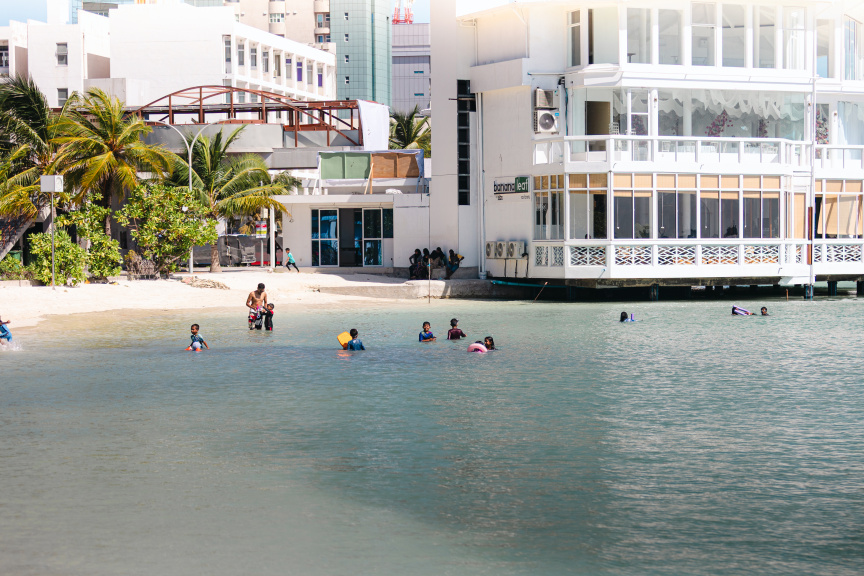
People swim at the Rasfannu beach in Male' City. (Sun Photo/Aaish Ashraf)
A couple of days ago, a friend of mine told me about how so many climate disasters have been happening around the world but a lot of them aren’t being broadcasted by the media. It posed a question in my mind:
The climate crisis is happening, but are we being told the full story?
Think about it—
When a disaster strikes, the first images often tell a familiar story. Floodwaters swallowing streets. Families standing on rooftops waiting for rescue. Homes reduced to rubble. People walking through destroyed communities searching for what remains. Or during a heatwave: crowded beaches, people trying to cool themselves down, weather maps showing record temperatures, and headlines warning of another “hot summer.”
But behind these images are stories that are much larger than the immediate event.
A flood is not only about water levels rising. It is about people losing homes, livelihoods, and access to basic necessities. A heatwave is not simply about uncomfortable temperatures. It is about public health risks, deaths, and communities being pushed beyond what they can safely endure.
The world is experiencing a climate crisis that is becoming increasingly difficult to ignore. Extreme heat, flooding, storms, droughts, and changing weather patterns are no longer distant predictions about the future. They are realities affecting millions of people today.
Yet, one of the biggest challenges is not only the crisis itself. It’s how the crisis is communicated.
Climate change is often visible everywhere around us, but the connections between these events are not always made clear. News reports frequently tell us what happened, but not always why it happened. The result is a dangerous gap between experiencing climate change and understanding it.

Journalism does not only record events. It shapes how societies understand those events. When climate-related disasters are presented as isolated incidents rather than part of a larger pattern, audiences may see the damage without understanding the cause.
And without understanding the cause, meaningful action becomes much harder.
Since much of the media continues to overlook this issue—or fails to portray it with the urgency and seriousness it demands—I feel it is important to speak about it. If this crisis is not being given the attention it deserves, then I will use this space to address it: to connect the events we are witnessing, examine what is being left unsaid, and remind readers that climate change is not a distant possibility, but an emergency already unfolding around us.
Note: I would like to thank my dear friend for bringing this important issue to my attention and helping me better understand the depth and urgency of the matter. Thank you as well for encouraging me to turn our shared research and discussions into this article.
No, it’s not “just the weather”

One of the biggest problems in climate reporting today is the way extreme weather is often separated from climate change itself. A heatwave becomes a weather story. A flood becomes a disaster story. A wildfire becomes an emergency story. But the most important question is often left unanswered:
Why are these events becoming more frequent and more severe?
In its reporting on European heatwaves, Al Jazeera highlighted how media coverage often fails to communicate the urgency of extreme heat. Despite the deadly consequences of rising temperatures, some coverage presented heatwaves through familiar summer imagery—beaches, outdoor activities, people enjoying the sunshine—rather than portraying them as serious public health emergencies.

This type of framing matters because visuals influence perception.
A photograph of people swimming during extreme heat communicates something very different from a photograph of elderly people struggling with dangerous temperatures, hospitals preparing for heat-related cases, or workers unable to safely continue their jobs outdoors.
Climate change is already difficult to communicate because it is not a single event that happens at one specific moment. It is a slow-moving crisis built through decades of emissions and environmental changes. Unlike a hurricane making landfall or an earthquake destroying buildings, climate change often appears through patterns.
This makes journalism even more important. People rely on media for proper news reporting and broadcasting. They hope to stay informed through media, and hence, the media’s responsibility is to help audiences see the truth. To notice the pattern and understand it.
Reporting consequences without causes

A recurring criticism of journalism related to climate science is that news organizations often report the consequences of climate change without naming climate change itself. The UK-based Climate News Tracker, which analyzes how broadcasters connect environmental reporting with climate science, found that major broadcasters frequently covered climate impacts without explaining their connection to climate change.
This creates a situation where audiences receive pieces of an incomplete story. They hear:
“Temperatures have reached record levels.”
“Flooding has displaced thousands.”
“Storms are becoming stronger.”
But they may not hear:
“This is connected to a changing climate driven largely by human activity.”
Naomi Klein made a similar argument in her interview with Novara Media about heatwaves, China, and the danger of technofixes. She argued that mainstream media often treats extreme weather as individual events rather than explaining the larger systems behind them.
According to Klein, journalism should not only document the symptoms of the crisis, but also investigate the systems that create those symptoms; fossil fuel dependence, economic decisions, government policies, corporate influence, and political choices that shape climate action.
A disaster report that only describes destruction tells people what happened. A climate report explains why it’s happening.
A flood is more than a flood

Some climate disasters become international headlines while others disappear quickly, despite affecting thousands of lives. In Assam, India, severe flooding has repeatedly devastated communities, leaving people displaced and vulnerable. Reports from flood-affected areas have shown the extreme realities faced by families when rising waters force them to abandon their homes and escape to safety. For people living through these events, a flood is not just a weather update. It’s not just rainfall statistics. It’s a complete disruption of life. It means losing a home, losing income, losing access to education, losing security, and for many it also means losing loved ones. When these stories are reduced to short news updates, audiences may never understand the human reality behind climate disasters.
Audiences aren’t going to know that the people of Assam have been tying up their loved ones on trees so their bodies won’t drift away with the flood before seeking safety themselves. They do this, so that they can give them a proper burial later.
The question journalism must ask is not only:
“What happened today?”
It must also ask:
“What larger changes are making this possible?”
Is it an environmental issue or a human issue?

Another major problem is that climate change is still often treated as a specialized topic. Many newsrooms continue to place climate reporting mainly under environmental sections, as though it exists separately from everyday life.
But climate change affects almost every area of society. It affects healthcare because extreme heat increases health risks. It affects housing because floods and rising temperatures change where and how people can live. It affects economies, transportation, migration, and energy systems. As The Conversation argues, climate change should become an everyday story rather than something covered only during disasters or international climate conferences.
A story about rising electricity prices can also be a climate story. A story about food costs can also be a climate story. A story about public health can also be a climate story. Instead of only asking whether it’s a climate story or not, journalists should also ask how climate change is shaping this story.
The climate newsroom is shrinking

The decline of climate coverage is not simply because journalists do not recognize the importance of the issue. Many do. The problem is that journalism itself is facing a crisis. The Covering Climate Now webinar, “The State of Climate Journalism” highlighted a worrying trend: climate coverage is decreasing despite the climate crisis becoming more urgent.
The discussion pointed to shrinking climate teams, fewer specialized reporters, reduced newsroom budgets, and journalists losing climate-focused positions. The reasons are complex. Newsrooms today operate under enormous pressure. Breaking news constantly competes for attention; wars, elections, political conflicts, economic crises, international tensions, etc.
At the same time, financial pressures have forced many organizations to reduce staff and resources.
The Westminster Foundation for Democracy’s Media Capacity Report (2023) also highlighted another challenge: many journalists lack formal climate science training, and climate reporting is often treated as a specialized field rather than something that should be integrated across all reporting.
This creates another problem.
Climate change is one of the most important stories of our time, but many newsrooms do not always have enough resources or expertise to explain it properly.
Fear without solutions

Climate change reporting has another challenge: how to communicate urgency without creating hopelessness. The seriousness of the crisis should never be hidden, but simply repeating images of destruction without context or solutions can leave audiences feeling powerless.
The article “How Does the Media’s Negative Coverage of Climate Change Affect People?” by Kora discusses how constant disaster-focused reporting can contribute to climate anxiety, emotional exhaustion, and disengagement. This doesn’t mean climate reporting should become positive for the sake of being positive. It means journalism should tell the complete story. A complete story includes: the danger, the causes, the people affected, the responsibility, and the solutions.
The Covering Climate Now webinar emphasized that audiences still want climate stories. The problem is not that people have stopped caring. The problem is that climate stories need to be told in ways that connect with people’s lives.
The technology we celebrate

The way climate information is communicated becomes even more important as new industries emerge. During recent heatwaves in France, many shared impressive AI-generated videos showing extreme weather scenes and conditions—which is quite ironic because artificial intelligence itself has an environmental impact.
AI systems require massive data centres filled with thousands of servers. These facilities consume significant amounts of electricity and require cooling systems to prevent overheating. When the energy powering these systems comes from fossil fuels, it contributes to greenhouse gas emissions.
AI is not the primary cause of climate change, but the rapid expansion of AI and data centres adds pressure to global energy systems. The fact that many people don’t know this shows another problem: climate change is not only a scientific issue. It is also a communication issue.
People cannot make informed decisions about systems they don’t understand. And journalism plays a major role in making those connections visible.
Our country cannot afford to avoid this topic

For countries like the Maldives, climate change is not a distant international issue. It’s already part of everyday life. As a small island nation, our country has long been recognized as one of the countries most vulnerable to the impacts of rising sea levels and climate change. But beyond the larger conversations about sea-level rise, people are already experiencing changes in their daily lives.
The unbearable heat that makes ordinary activities exhausting.
Rapid changes in weather patterns that make planning difficult.
Periods of haze and unusual atmospheric conditions.
Changing rainfall patterns.
Increasing concerns about coastal environments and marine ecosystems.

These are not abstract climate predictions. They are experiences people are already noticing. Yet, climate reporting in the Maldives often still focuses on individual weather events rather than consistently connecting them to the larger climate story. Local media has a powerful role to play here. Climate journalism doesn’t mean only reporting on international climate conferences or scientific reports. It means asking questions relevant to ordinary people:
How is rising heat affecting public health?
How are changing weather patterns affecting fishermen?
How are coastal communities adapting?
How will climate change affect future generations?
Maldivian media organizations have the opportunity—and responsibility—to make climate change a regular part of public conversation, not only when a disaster occurs. Because for a country surrounded by the ocean, the climate story is not happening somewhere else.
It is already here.
Let’s talk about El Niño

Forecasts indicate that El Niño is developing rapidly and could become significantly stronger as 2026 progresses. El Niño is a naturally occurring climate pattern in which the surface waters of the central and eastern tropical Pacific Ocean become warmer than usual, influencing atmospheric conditions and altering weather patterns across the globe. Depending on the region, it can contribute to extreme heat, droughts, heavy rainfall, flooding, and other climate-related disruptions.
While El Niño itself is part of a natural climate cycle and is not caused by human-driven climate change, its impacts are now unfolding in an already warming world. This means that the additional heat caused by El Niño can intensify existing climate risks and increase the possibility of record-breaking global temperatures and more extreme weather events. With forecasts suggesting that this El Niño could reach strong or even historically significant levels, communities around the world may face greater climate-related challenges through late 2026 and into early 2027.
As these changes develop, the need for accurate and responsible climate reporting becomes even more urgent. People need more than just updates about rising temperatures, storms, or changing weather patterns; they need explanations of what is happening, why it is happening, and how these events connect to the larger climate crisis. Without that context, extreme weather can continue to appear like isolated incidents rather than part of a wider and rapidly evolving global problem.
Are we telling the story honestly?

The climate crisis is no longer a future warning. It is present in the heatwaves taking lives, the floods destroying communities, and the changing environments people are learning to live with. The role of journalism is not only to tell people what happened. It is to help them understand why.
When media reports disasters without explaining their causes, audiences are left with images of destruction but without the knowledge needed to respond. The world is changing. The responsibility of journalism is to make sure people understand that change. Because the climate story is not only about weather.
It is about people.
It is about systems.
It is about choices.
And above all, it is a story that cannot afford to be misunderstood.
Sources (highly recommend checking them out):