date_range
Monday 05 Oct 2026


 LOCAL EDITION
close
 LOCAL EDITION


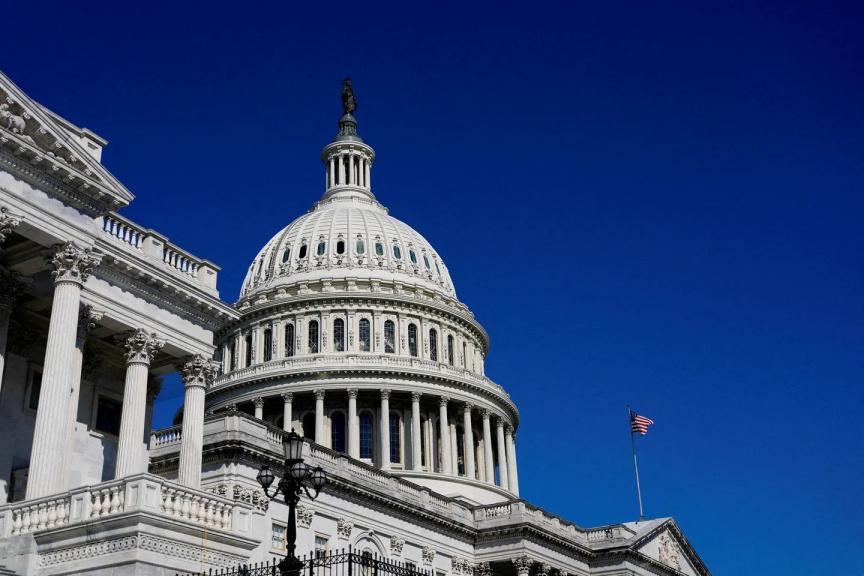
US House of Representatives has rejected a bold legislative amendment to eliminate $3.3 billion in annual US military aid provided to Israel. (Photo/Reuters)
The US House of Representatives has rejected a bold legislative amendment to eliminate $3.3 billion in annual US military aid provided to Israel.
Yet, the final tally revealed a historic realignment within the Democratic Party that would have been unthinkable just a few years ago: 103 House Democrats voted in favour of the cuts, marking an unprecedented challenge to Washington's decades-old consensus on Middle East policy.
The amendment, sponsored by Republican Representative Thomas Massie, ultimately failed in a 314-104 vote.
However, the fact that nearly half of the 212-strong House Democratic caucus chose to support the measure highlights how deeply the genocide in Gaza has fractured the party's base and its lawmakers.
It serves as a stark warning to the party's establishment ahead of November's crucial midterm elections.
Democratic leadership splits
The dramatic floor vote exposed an unusual and highly visible split at the very top of the Democratic hierarchy.
While House Minority Leader Hakeem Jeffries voted against the amendment—describing it as "overly broad" and warning it would impact diplomatic capabilities—he notably chose not to formally persuade or "whip" his colleagues to oppose it.
Jeffries acknowledged the "strongly held views throughout the caucus" on the war, reflecting a leadership team keenly aware of shifting tides.
In contrast, House Democratic Whip Katherine Clark, the second-highest-ranking Democrat in the lower chamber, openly broke with Jeffries to vote in favour of the aid freeze.
Clark argued that the Netanyahu government has failed to meet basic standards, stating that the United States must change course.
She was joined by high-profile colleagues, including Representative Robert Garcia, the ranking member of the House Oversight Committee, who took aim at the Israeli Prime Minister directly, calling him “a corrupt authoritarian who should face criminal courts—not receive billions more for weapons.”
Systemic political realignment
Across the US, primary voters are increasingly punishing incumbents who maintain an uncritical stance toward the Netanyahu government.
In New York last month, primary voters ousted two sitting establishment Democrats and replaced them with democratic socialists who put Palestinian human rights at the centre of their campaigns.
This trend repeated in Colorado, where longtime progressive Congresswoman Diana DeGette lost her primary in a stunning upset to Melat Kiros, a political newcomer who campaigned aggressively on cutting military funding to Israel.
Furthermore, hardline stances on Israel are expected to dominate upcoming high-profile primary races in Missouri and Michigan, directly challenging the influence of the American Israel Public Affairs Committee.
With the Congressional Progressive Caucus officially endorsing the aid freeze, the vote demonstrates that what was once a fringe position on Capitol Hill has now become a mainstream, defining battleground for the future of the Democratic Party.
__
Source: TRT