date_range
Tuesday 06 Oct 2026


 LOCAL EDITION
close
 LOCAL EDITION


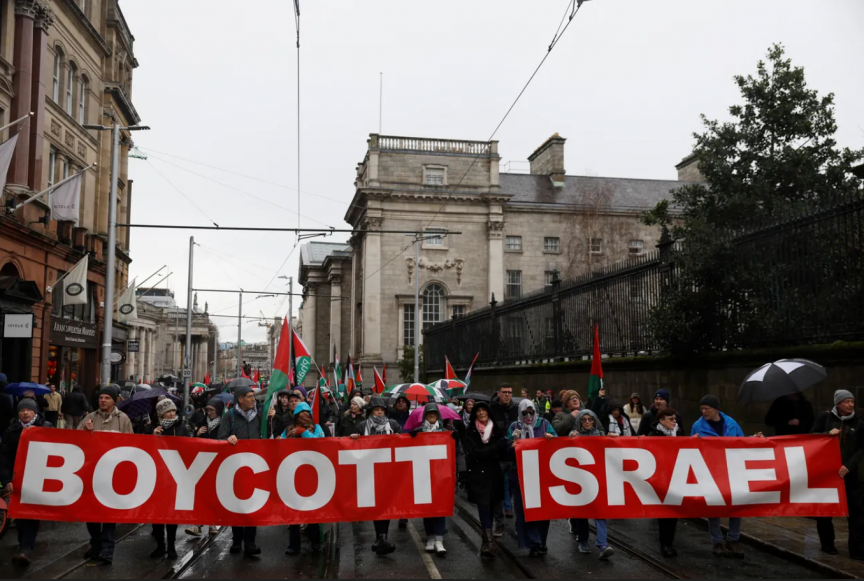
Demonstrators hold banners in support of Palestinians during a protest for Gaza, in Dublin. (Photo/ Reuters)
Ireland's parliament has approved legislation banning imports of goods from Israeli illegal settlements in the occupied Palestinian territories, as Dublin presses ahead with one of Europe's most far-reaching trade measures over Israel's occupation.
The Israeli illegal Settlements (Prohibition of Importation of Goods) bill prohibits the import of goods from "certain Israeli illegal settlements".
Those include residential, agricultural and business interests that lie outside Israel's internationally recognised borders.
While Ireland was the first EU country to propose such a ban, Spain already implemented a package of import restrictions last October.
The centre-right coalition government, which drafted the legislation, has said its wording was guided by an advisory opinion by the International Court of Justice (ICJ) in 2024.
The ICJ said Israel's occupation of the West Bank, East Jerusalem and invasion of Gaza was illegal under international law.
Ireland has been among the most outspoken critics of Israel's genocide in Gaza.
It recognised a Palestinian state in 2024.
Soon after, Israel's Foreign Minister Gideon Saar ordered the closure of its Dublin embassy, blaming Ireland's "extreme anti-Israel policies".
Last month Dublin banned Israeli National Security Minister Itamar Ben Gvir and finance minister Bezalel Smotrich from entering the country, slamming their behaviour towards pro-Palestinian activists.
Dublin has also long pushed for a review of the European Union's EU-Israel Association Agreement, a cooperation deal signed in 1995 that forms the basis for trade ties with Israel.
The bloc said last month it would examine options to restrict trade with Israeli illegal settlements.
But there remains no consensus among the bloc's member states to take further steps against Israel.
Opposition politicians in Dublin criticised the bill — which moves to the upper house for final approval — for not going far enough by leaving out trade in services.
The government has argued that a ban on the trade of services is more complex than goods and the bill needs to be legally watertight before it is enacted.
___
Source: TRT