date_range
Sunday 06 Sep 2026


 LOCAL EDITION
close
 LOCAL EDITION


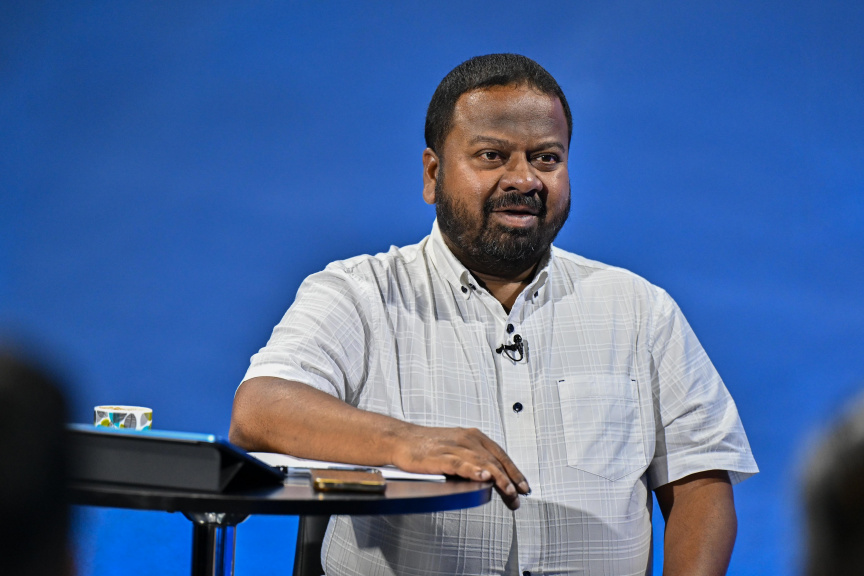
The President’s Office’s Chief Spokesperson Mohamed Hussain Shareef (Mundhu) speaks at the ‘Presser with Spox’ press conference on May 7, 2026. (Photo/President's Office)
The President’s Office’s Chief Spokesperson Mohamed Hussain Shareef (Mundhu) states that certain pledges made by President Dr. Mohamed Muizzu during his presidential campaign and after assuming office may be subject to change depending on prevailing circumstances and time, adding that adjustments have already been made to some.
He made the remark while responding to a journalist’s question during the ‘Presser with Spox’ press conference held at the President’s Office on Thursday afternoon.
Mundhu pointed out that President Muizzu’s electoral pledges have already been published and remain accessible to the public. However, he emphasized that since many of these commitments were made prior to assuming office, it became necessary to reassess certain pledges after assuming office and assessing the realities of the current situation.
“The electoral pledges have also been published. It becomes a pledge once we assume office, depending on the situation… We have also revised some pledges based on the situation,” Mundhu said.

Referring to the number of political appointees, Mundhu explained that the proposal to limit political staff to no more than 700 had been put forth by the President during the transition period. However, he clarified that this figure was later reviewed after taking office and assessing the practical requirements of governance. He further noted that state-owned enterprises (SOEs) had been instructed to reduce their workforce by one-third as part of broader cost-reduction measures, adding that the process is currently in progress.
Addressing requests submitted under the Right to Information (RTI) Act, Mundhu affirmed that the government would respond to inquiries made in good faith. Nevertheless, he stressed that certain categories of information cannot be disclosed under the law, including matters that may affect foreign relations, confidential provisions within financial agreements, and matters concerning national security.
Concluding his remarks, Mundhu added that even pledges outlined in presidential addresses delivered after assuming office may be revised in accordance with the country’s prevailing situation.