
date_range
Monday 07 Sep 2026


 LOCAL EDITION
close
 LOCAL EDITION


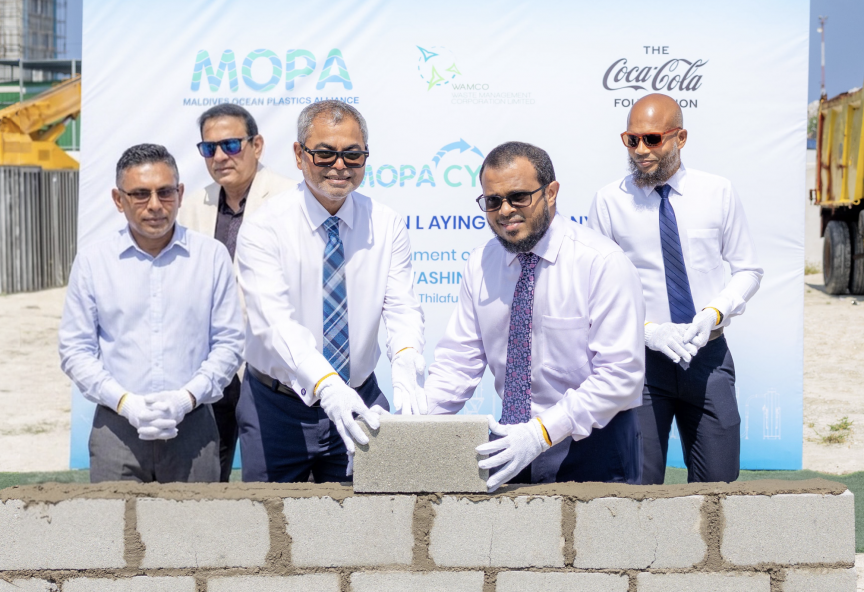
Groundbreaking held for Maldives' first plastic recycling facility, MOPA CYCLE PET Flaking and Washing Line Facility, on May 6, 2026.
The groundbreaking for “MOPA CYCLE PET Flaking and Washing Line Facility” was held in Thilafushi on Wednesday, marking a major milestone in efforts to protect the Maldives’ delicate environment and strengthen the national waste management system.
The facility will be the first of its kind in the Maldives and is designed to recycle discarded PET plastics, including water bottles, into reusable raw materials.
Launched by the Maldives Ocean Plastics Alliance (MOPA), the project represents a significant step toward expanding the country’s recycling infrastructure and developing a circular economy for plastic waste management.
Environment Minister Ali Shareef and former Environment Minister Thoriq Ibrahim laid the foundation stone for the facility.
The 5,000-square-foot facility at Thilafushi will include a full PET plastic processing line. The process will involve collecting waste from islands across the country, removing bottle labels and caps, shredding the plastic into flakes, and carrying out multiple stages of washing using both hot and cold water before drying.
The facility will also house a dedicated Effluent Treatment Plant (ETP) designed to remove microplastics from wastewater generated during processing which has been underscored an essential component in ensuring that the recycling operation remains environmentally sustainable.
Once operational, facility will increase the value of plastic waste generated in the Maldives by converting it into high-quality materials suitable for use in textiles and other recycled products. The initiative is also expected to create opportunities for the country to generate economic value from waste domestically, rather than exporting recyclable materials overseas.

Speaking at the ceremony, MOPA President Ahmed Maumoon said the organization has been working since its establishment to identify practical and sustainable solutions to plastic waste management. He noted that the facility would enhance the usability of collected PET plastics and elevate recycling efforts in the Maldives.
“PET plastic should no longer be regarded simply as waste. With the right systems, partnerships and infrastructure, it can be turned into a valuable resource that supports a circular economy and contributes to a cleaner Maldives. This project will allow us to triple the volume of PET currently collected and exported for recycling,” Maumoon said.
Minister Ali Shareef highlighted the challenges associated with waste management in the Maldives and stressed the importance of collaborative efforts in developing sustainable solutions.
The Minister described the MOPA CYCLE facility as an important addition to the country’s waste management network. He also expressed hope that the initiative would eventually expand into industries such as recycled yarn production and emphasized the need for similar projects to be implemented across other regions of the Maldives.
MOPA also acknowledged the support and cooperation received from government agencies and organizations, including Waste Management Corporation Limited (WAMCO) and Housing Development Corporation (HDC), in advancing the project. The alliance further recognized the continued assistance provided by The Coca-Cola Foundation since the establishment of MOPA.
The Senior Director of Sustainability and Value Creation for Coca-Cola India and Southwest Asia stated that the company’s work in the Maldives is focused on three main areas: developing infrastructure for packaging waste management, building partnerships to collect and convert waste into reusable resources, and strengthening collaboration among key stakeholders.
Construction of the facility, which is being supported by multiple partners, is expected to be completed within the next nine months.
The MOPA CYCLE project is regarded as a major step toward achieving MOPA’s long-term goal of establishing recycling infrastructure across different regions of the Maldives. Once operational, the facility is expected to significantly transform the country’s waste management sector and help reduce environmental degradation.
