date_range
Tuesday 20 Oct 2026


 LOCAL EDITION
close
 LOCAL EDITION


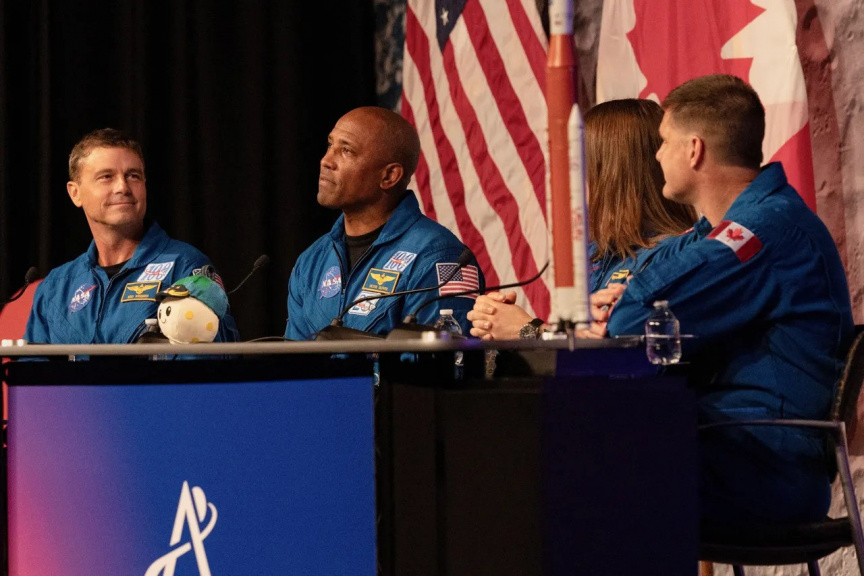
Nearly a week after their Pacific splashdown, the astronauts who crewed the Artemis II mission that flew around the Moon, speake to reporters from NASA’s Johnson Space Center in Houston, their home base. (Photo/Reuters)
Nearly a week after their Pacific splashdown, the astronauts who crewed the Artemis II mission that flew around the Moon have told reporters they have yet to fully grasp the magnitude of the moment.
"It's been a week of medical testing, physical testing, doctors, science objectives," mission commander Reid Wiseman said on Thursday during a press conference at NASA's Johnson Space Center in Houston.
"We have not had that decompression," he added.
The 50-year-old led fellow Americans Victor Glover and Christina Koch, and Canadian crewmate Jeremy Hansen, on a mission that took them farther into space than anyone has ever gone before.
Adjusting to life on Earth is taking a beat.
"Tomorrow will be one week, and I was just trying to live in a little hole for one week, been off social media, not on the news. So, no, I don't know," Glover, who piloted the mission, told reporters.
Wiseman said he and Glover "maybe saw two moments of a touch of char loss" to the heat shield as Integrity plunged through the fastest, hottest part of reentry.
Once aboard the recovery ship, they peered at the bottom of the capsule as best they could, leaning over to view any signs of damage. They spotted a little loss of charred material on the shoulder, where the heat shield meets the capsule.
"For four humans just looking at the heat shield, it looked wonderful to us. It looked great, and that ride in was really amazing," Wiseman said.
He cautioned that detailed analyses still need to be conducted. "We are going to fine-tooth comb every single, not even every molecule, probably every atom on this heat shield," he said.
Historic mission
Artemis II was the first crewed mission to venture to the Moon's orbit since 1972, and the only one in history to include a woman, or a Black astronaut, or a non-American.
Their voyage was broadcast live by the US space agency NASA, and the media coverage of the launch and return to Earth was watched by millions of people.
For Koch, waking up to the reality means remembering that gravity has taken hold.
"In the first few days, I thought I was floating. I truly thought I was floating, and I had to convince myself I wasn't," Koch said.
Koch added that since returning, she and her crewmates are "feeling even more excited and just ready to take that on as an agency."
"We made it happen," she added.
Their mission lasted almost 10 days, but NASA has ambitions to return to the Moon for longer visits to establish a base in preparation for future missions to Mars.
The United States is targeting a lunar landing in 2028, before the end of President Donald Trump's term and a deadline set by rivals in China.
___
Source: TRT