date_range
Sunday 06 Sep 2026


 LOCAL EDITION
close
 LOCAL EDITION


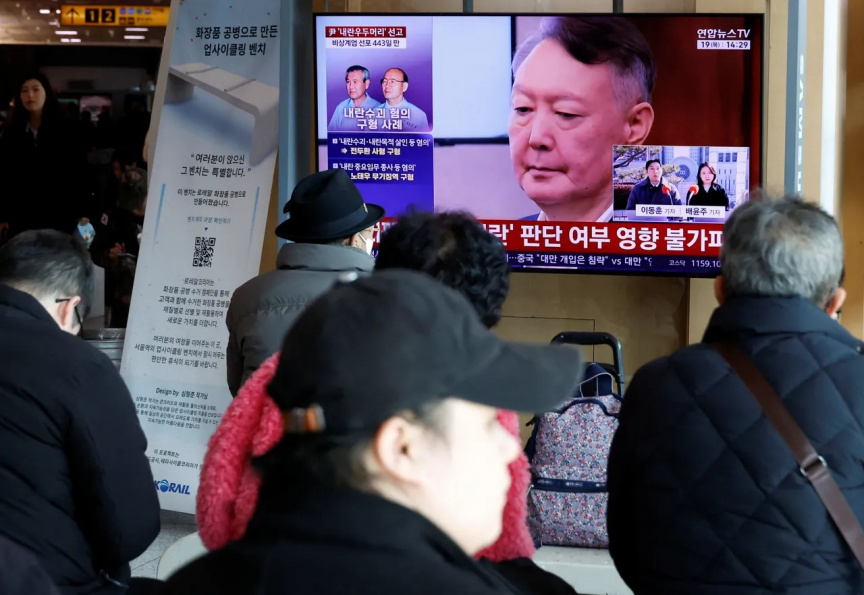
People watch a news report on the sentencing trial of South Korean former president Yoon Suk Yeol's insurrection case on February 19, 2026. (Photo/Reuters)
A court in South Korea has sentenced former president Yoon Suk-yeol to life in prison after finding him guilty of leading an insurrection through his shock declaration of martial law in 2024.
Delivering the verdict on Thursday at the Seoul Central District Court, presiding judge Ji Gwi-yeon said Yoon’s decision to deploy troops to the National Assembly aimed to silence political opponents and halt parliamentary activity.
“The intention was to paralyse the assembly for a considerable period,” the judge said, adding that the declaration imposed high social costs and that the former president had shown little remorse.
Yoon, 65, stunned the nation in December 2024 when he appeared on live television to announce martial law, claiming drastic action was needed to root out “anti-state forces” in parliament.
The order suspended civilian governance and triggered panic in financial markets, protests on the streets, and alarm among allies, including the United States.
The measure collapsed within six hours after lawmakers rushed to the assembly and voted to overturn it, with staff barricading doors using office furniture to block armed troops.
Yoon was subsequently impeached, arrested, and charged with a string of crimes, including insurrection and obstruction of justice.
Prosecutors argued he had been driven by a desire to cement long-term rule, urging the court to impose the death penalty — the only alternative sentence under South Korean law for insurrection.
The country maintains an unofficial moratorium on executions, meaning a death sentence would effectively translate into life behind bars.
Former defence minister Kim Yong-hyun was sentenced to 30 years in prison for his role in the crisis, while other senior officials also face prosecution.
Outside the courthouse, thousands of Yoon supporters gathered, waving placards and chanting slogans, while police erected barricades and deployed in large numbers to prevent unrest.
South Korea, long viewed as one of Asia’s most stable democracies, was shaken by the episode, which revived memories of the military coups that dominated the country’s politics from the 1960s to the 1980s.
Yoon has denied wrongdoing, insisting he acted to “safeguard freedom” and defend constitutional order against what he described as an opposition-led “legislative dictatorship.”
The former president’s legal troubles extend beyond the insurrection case. Earlier this year, his wife, Kim Keon-hee, was sentenced to prison on separate bribery-related charges.