date_range
Tuesday 09 Jun 2026


 LOCAL EDITION
close
 LOCAL EDITION


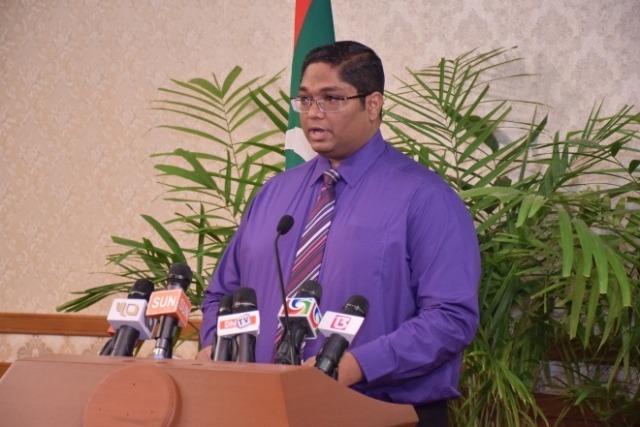
Maldives President Abdulla Yameen has declared state of emergency for 30 days and curtailed some constitutional rights.
The president’s statement declaring emergency was delivered by Attorney General Mohamed Anil at a press conference at the President’s Office Wednesday morning.
The articles of the Constitution that have been restricted are:
Article 19 (Freedom from restraint): A citizen is free to engage in any conduct or activity that is not expressly prohibited by Islamic Shari’ah or by law. No control or restraint may be exercised against any person unless it is expressly authorised by law.
Article 24 (Privacy): Everyone has the right to respect for his private and family life, his home and his private communications. Every person must respect these rights with respect to others.
Article 31 (Right to strike): Every person employed in the Maldives and all other workers have the freedom to stop work and to strike in order to protest.
Article 32 (Freedom of assembly): Everyone has the right to freedom of peaceful assembly without prior permission of the State.
Article 41 (Freedom of movement and establishment) (a) Every citizen has the freedom to enter, remain in and leave the Maldives, and to travel within the Maldives.
Article 45 (No unlawful arrest or detention): Everyone has the right not to be arbitrarily detained, arrested or imprisoned except as provided by law enacted by the parliament in accordance with Article 16 of this Constitution.
(This restriction excludes unlawful arrest or detention)
Article 47 (Search and seizure): (a) No person shall be subject to search or seizure unless there is reasonable cause. (b) Residential property shall be inviolable, and shall not be entered without the consent of the resident, except to prevent immediate and serious harm to life or property, or under the express authorisation of an order of the Court.
--
In addition to these restrictions, the Freedom to Peaceful Assembly Act has been suspended for 30 days.
The state of emergency follows security forces intelligence that confirm the threat of an imminent attack using weapons and explosives. The president said in the declaration that this poses a threat to public safety.
The state of emergency was put in place following advice from the National Security Council.
The declaration further states that weapons and explosives have been found in two locations in operations conducted by security forces following the 28 September explosion on the president’s speedboat.
Security forces believe some weapons remain missing.
Attorney General Anil said the declaration has been sent to the parliament, in accordance with Article 257 of the Constitution.
Article 257, which refers to the submission of declaration to the parliament, states that the declaration of a state of emergency shall be submitted to the parliament within forty eight hours. If the parliament is not in session at the time of the declaration, it shall be recalled within fourteen days, inclusive of holidays, and the declaration of a state of emergency submitted to the parliament for approval.
The parliament may approve the declaration in whole or in part.
Despite the state of emergency, no curfew has been announced.